
Venezuela joins South American trade bloc
CORDOBA, Argentina – Venezuela formally entered Mercosur on Friday, increasing the South American trade bloc’s economic might and vowing to transform the once-sleepy policy organization into a force for profound social change.
President Nestor Kirchner welcomed the “historic” addition of oil-rich Venezuela, the continent’s No. 3 economy after Brazil and Argentina, launching a round of speeches by Latin America’s leading leftists, who asserted the region’s independence from a Washington model many of their citizens see as a failure.
President Hugo Chavez of Venezuela immediately urged Mercosur to put aside internal squabbles and stand against the U.S.-backed free-market policies he says “enslaved” the region in debt to the International Monetary Fund.
“Latin America has all it needs to become a great world power. Let’s not put any limits on our dreams. Let’s make them reality,” the Venezuelan leader declared.
The addition of Venezuela gives Mercosur a combined market of 250 million people and a combined output of $1 trillion in goods and services annually, said Brazil’s president, Luiz Ignacio Lula da Silva.
NAFTA, combining the markets of the United States, Canada and Mexico, has 450 million consumers and a combined gross product of about $14 trillion.
Still, Silva said “no one’s talking anymore” about the U.S.-backed Free Trade of the Americas proposal blocked by Venezuela and the Mercosur nations last year.
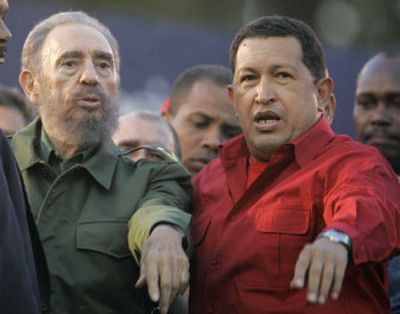
Cuban President Fidel Castro and Bolivian President Evo Morales, taking part as observers, applauded their ally Chavez, who praised Castro’s willingness to send doctors and teachers to their countries. Chavez said the Cuban leader “can help us all a great deal” as Mercosur makes greater efforts to end poverty, hunger and joblessness.
“We are entering a new stage of Mercosur,” Chavez said.
Kirchner agreed, saying a growing Mercosur should fight inequality as a way of bolstering their nations’ economies and helping them compete in the global economy.
The Mercosur leaders also concluded a deal Friday to foster greater trade with Cuba, despite a 45-year-old U.S. embargo of the island. Such developments have worried those who lament the decline of U.S. influence in the region. Michael Shifter, an analyst at the Inter-American Dialogue in Washington, said Venezuela’s entry should be a “wake-up call” for U.S. officials who have been distracted from Latin America by conflict in the Middle East. “Mercosur seems to have less and less to do with free trade and more to do with politics,” he said.