
Risch would up sales tax to lower property taxes
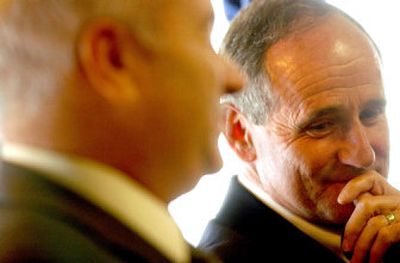
Gov. Jim Risch called a special session of the Legislature on Tuesday to consider his property tax relief plan and said his bill – to raise the sales tax 1 cent and cut property taxes – will be the only one considered at the one-day session next month.
“It needs to be simple and it needs to be basic,” Risch said. “Without that, you’re never going to get the votes.”
In press conferences Tuesday in Coeur d’Alene, Idaho Falls and Boise, Risch was accompanied by House Speaker Bruce Newcomb and Senate President Pro-Tem Bob Geddes, both of whom predicted Risch’s plan would easily pass both houses.
“A lot of things have changed since the session adjourned in April,” Geddes said. “We didn’t know that we’d have a $200 million surplus. We also have a governor that is willing to sign the plan into law.”
That comment drew applause from an audience of supportive North Idaho legislators, many of whom have been pushing hard for various property tax relief proposals, including seven bills that passed earlier this year.
“I have worked hard to keep this issue at the top of the state’s priority list and am encouraged by the governor’s decision to call a special session of the Legislature,” said Sen. Shawn Keough, R-Sandpoint, who co-chaired a legislative committee that held hearings across the state on the issue last summer.
Rep. Frank Henderson, R-Post Falls, said, “Finally somebody went to work on the second floor.” That’s the floor in the state Capitol that contains the governor’s office.
Risch’s plan has five key parts:
“Eliminate the $3 per $1,000 property tax levy that funds basic school operations. That would cut $260 million in property taxes for all classes of property, including homes, businesses, farms and utility property.
“Raise the sales tax to 6 percent, from 5 percent, on Oct. 1, generating an additional $210 million a year.
“Shift $50 million from the state’s $203 million budget surplus to make up the rest of the lost school funding.
“Add another $100 million from the surplus to a special savings account for schools that now holds $13 million, to hedge against future economic downturns that could affect the state’s sales tax revenues.
“Place an advisory ballot measure before voters in November asking if they approve of the change.
House Assistant Minority Leader George Sayler, D-Coeur d’Alene, said, “I’m disappointed that this is a one-bill session. I would like to have the Democratic plan have an opportunity to be heard and be debated on as well. I think that would be a more open process.”
Idaho Democrats have proposed instead using $104 million in surplus funds to eliminate the school levy only for homeowners, leaving the levy in place for businesses, farms and utility property.
“There’s no tax increase, there’s no tax shift. It targets the relief where it’s needed, and it doesn’t give relief to out-of-state owners that Idaho taxpayers are going to be subsidizing with a sales tax increase,” Sayler said.
But Rep. Mary Lou Shepherd, D-Prichard, joined eight Republican legislators from North Idaho at Risch’s Coeur d’Alene press conference to support the plan.
“I’m elated with it,” Shepherd said. “The No. 1 issue is tax relief, and not just for the resident homeowners.”
Sayler, who returned from an out-of-town trip just hours after Risch’s announcement, said he was pleased to hear of the $100 million rainy day fund for schools. “I think that’s a very worthwhile step,” he said.
Keough said, “Property tax relief is paramount in people’s minds, but they also want to make sure that the education system is kept whole. With this package the governor’s crafted, it’s clear that we’re sincere about protecting education.”
Henderson and Rep. Bob Nonini, R-Coeur d’Alene, said they’re working on several follow-up bills to propose in January, including a sharp increase in the grocery tax credit. Idaho is one of a minority of states that fully taxes groceries with its sales tax.
Said Nonini, “I understand everyone’s concern about the sales tax increase for the low-income people, the fixed-income people. They’ve still got to eat. If we raise the sales tax a penny, there are going to be some people that are going to feel that.”
But he and Henderson said the property tax issue is even more pressing, and both strongly backed passing Risch’s bill right away.
Risch said, “In a perfect world, you might expand that (grocery tax credit) to reflect the additional 1 cent.” But he said the bill he negotiated with legislators that had the votes to pass both houses didn’t include that piece.
“It has to get 18 votes in the Senate and 36 votes in the House, because without that, it’s only an idea,” Risch said.
The Idaho Center on Budget and Tax Policy released an analysis Tuesday estimating that 95 percent of Idaho families would see a net tax increase under Risch’s plan, because of the sales tax hike.
“Only families with incomes above $135,000 will, on average, see a net tax decrease,” wrote economist Judy Brown.
Risch said the impact of the sales tax hike will vary. “Every person is different,” he said.
Risch said he wanted to move ahead with the change now so it would be reflected on the property tax bills that Idahoans will pay in December. “I’ll be the first to admit this is a major, major change to the tax system in Idaho,” he said. But, he said, “It’s time to do that.”