
A shrinking sisterhood

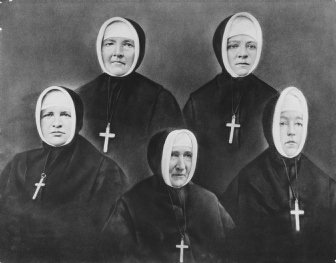
It’s the third time in as many months that the Sisters of Providence have lost one of their own.
Sister Therese Eugenie Belisle, 94, died last week in Spokane, leaving only 175 vowed women to tend the social and spiritual needs of a region that once boasted more than 750.
But you’ll see no sadness here, in the warm chapel of Mount St. Joseph, early on this Monday morning. Before a sparse gathering of mostly women – mostly in walkers, wheelchairs and sensible sandals – the remaining community members commit their colleague to God.
The passing of this single sister is a bittersweet occasion, they say. It’s the loss of a smiling friend and an efficient, orderly soul. But it’s also the fulfillment of a lifetime of service in the model of their founder, Mother Joseph.
And if the rest of their ranks are thin, even as they mark the 150th anniversary of the Sisters of Providence in the West, well, the sisters say, it must be the will of the Lord.
“We shall go up with joy to the house of our God,” sing Sister Therese’s pallbearers, warbling the old hymn over her casket in clear, calm voices.
“ “ “
To be frank, worry about the dwindling numbers of religious women is old news to Sister Margaret Botch, the provincial superior for the region that encompasses six Western states and El Salvador.
She fixes a visitor with a firm gaze as she explains that the goal of ministering to the poor and vulnerable does not depend on a head count.
“If you just focus on the sisters, you’re not getting the point of the celebration,” Sister Botch says. “We’re marking 150 years of a mission. That has never been something that the sisters have done alone.”
Still, she and others concede that the statistics are sobering. There are fewer sisters than ever across the nation and around the world, according to the Center for Applied Research in the Apostolate, a Catholic data agency.
In the past 40 years, the number of religious sisters in the United States has plummeted by more than 60 percent, falling from about 180,000 sisters in 1965 to fewer than 70,000 last year.
Worldwide, their ranks declined by nearly a quarter between 1970 and 2004, from more than a million to nearly 780,000 across the globe, figures showed.
At the same time, the sisters who remain are growing older. Their average age is 69, figures show, with many who took vows in the 1930s and 1940s now approaching 80 and 90.
“I’m 89 years young,” says Sister Dorothy Zimny, a Spokane member who found her vocation after being sent to live with nuns as a teenager in Sprague, Wash. She’s now marking her 70-year jubilee.
“My brother kept asking me, ‘Dorothy, do you want to come home?’ ” she recalls. “I told him, ‘This is what I want to do.’ ”
Seven decades later, Sister Dorothy still believes that decision was the right one. She originally was attracted by the sisters’ compassion for the poor and by the possibility of instilling that quality in others. When she hears now from long-grown students doing good work, she knows she has succeeded.
“I feel good knowing that they’re touching other souls who need special help,” she says.
Individual accomplishments are rewarding, but both she and Sister M. Michelle Holland, 79, who is celebrating 60 years of service, say they’re most proud of the Sisters of Providence’s lingering legacy.
From the area’s first hospitals and schools to nursing homes, day care centers and transitional housing, Mother Joseph and her followers created enduring institutions.
“That’s a long time helping people,” Sister Michelle said. “There’s the permanence of that that lasts much longer than any sister.”
But both sisters acknowledge that their vocation was shaped, in large part, by the time when they made their commitment.
“There weren’t the same opportunities for women,” says Sister Michelle, who grew up in a small Idaho lumber town.
Women interested in travel, in education, in an alternative to traditional family life, could find structure, community and service in the sisterhood. When society shifted, first with the church reforms of Vatican II, then with the social changes in the U.S. in the 1960s, new options made a vowed life less attractive.
More recently, the clamor of modern society and the decline of traditional family structures have contributed, perhaps, to a dearth of Americans accepting vocations, they say.
“They’re so overwhelmed in this information age,” Sister Michelle observes. “They can’t even walk down the street without listening to an iPod.”
Adds Sister Dorothy:
“It isolates us and doesn’t let us see each other or let us even glorify God that the sun is shining,” she says. “We’re not letting young people experience leisure, and it takes a certain amount of leisure to contemplate life.”
Increasingly, new devotees attracted to the sisterhood come from other countries. Spokane’s two newest novices are from El Salvador; another sister-in-training is from Canada by way of Hong Kong.
At the novitiate house in northeast Spokane, six women from four cultures share daily life and spiritual training. They include Sister Margarita Hernandez, 25, and Sister Vilma Franco, 27, from El Salvador, and Sister Christina Wong, who is from the Holy Angels Province in Edmonton. Sister Christina says her culture prevents her from revealing her age, but she’s twice as old as the younger women.
The new sisters’ motivation ranges widely. Sister Vilma lost her father and six brothers in her country’s bloody civil war. Sister Margarita came from a poor family where her dreams of becoming a psychologist were dismissed. Sister Christina cared for her ill parents until their deaths and then chose the same path as her sister.
“The thing that caught my eye was how they gave such service of love,” says Sister Margarita, who was a 14-year-old schoolgirl when the Sisters of Providence came to live in her village.
At first, she didn’t accept the idea of becoming a sister.
“The calling, it did felt like it did not come from me, the sisters just kept asking,” she says through a translation provided by Sister Josie Ramac, 62, who’s from the Philippines.
Recent years have brought strong calls for intensive recruiting efforts for religious men and women alike. Like others, the Mother Joseph Province holds regular “Come and See” sessions for young women considering the calling.
But neither Sister Dorothy nor Sister Michelle worries about the precipitous drop in their ranks.
“I don’t think religious communities try to convert,” says Sister Michelle. “God does this in the heart of the young women.”
After lives spent as teachers and health care providers, the sisters figure there are many ways to shape minds and heal bodies and souls.
One alternative is through the works of lay people with shared goals. The Providence Associates, a group of about 280 men and women, Catholics and not, may offer that option.
“Primarily, we have the same shared focus and passion for community, for spiritual growth,” says Marie Ilch, 71, a co-director of the organization. “I believe that there has always been, in some form or another, a call that people hear.”
The change in ministry may be form of natural succession, some church leaders have suggested, in which one entity makes way for the next to achieve the same aims.
“If it’s going to take celibate women living in community do God’s work, God’s going to provide those numbers,” Sister Michelle says. “If it’s going to take a few of us influencing others, then that’s what we’re about.”