
Targeting bird flu
Bird-flu threat doesn’t deter waterfowl hunters
Joe Ford isn’t worried about avian flu.
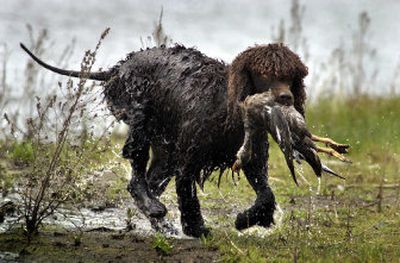
The avid duck hunter from Pullman, said he intends to go out this fall shooting and eating wild game even if there is a possibility ducks and geese could bring a virulent strain of the disease to North America.
“I’m not worried about it myself,” he said. “I’m not going to pick up ducks I find staggering around, but if I shoot pheasants or ducks or geese I’m going to cook them like I always do and enjoy them.”
Ford, the Whitman County chairman for Ducks Unlimited, a nationwide conservation and hunting group, isn’t burying his head in the sand. He, like many hunters, has researched the disease and is taking advice from experts who believe wild waterfowl could carry the disease from the Arctic to the United States. These same experts also say infected birds that are cleaned using sound hygiene and cooked to the appropriate temperature are safe to eat.
“Most people who really enjoy bird hunting or duck hunting, I don’t think they will let it deter them,” Ford said.
What he, other hunters and the experts are more unsure of is how avian flu, which is first and foremost a bird disease, may affect populations of wild birds. There are hundreds of strains of avian flu. Many of them are carried by wild birds but few are considered highly pathogenic.
The H5N1 version of the disease is considered especially dangerous to domestic poultry and it is believed it mutated from a common virus to a dangerous one during exposure to domestic birds. It was centered in Southeast Asia but last year the disease began spreading across Asia and into Europe, the Middle East and central Africa, where it infected several species of wild birds and some mammals.
To date it has not been responsible for massive die-offs of birds in Europe, Asia or Africa. Bruce Batt, a wildlife biologist with Ducks Unlimited based in Memphis, Tenn., said ducks seem to be carriers that are not highly affected by it. Geese, however, are affected and there have been some significant die-offs recorded in Asia. Last July, more than 1,000 endangered bar-headed geese were found dead at a refuge in China.
The disease has killed nearly 100 species of birds, including chickens, several species of ducks and geese such as Canada geese, wood ducks, gadwall and teal. It has killed upland game birds like ring-necked pheasants, chukar, partridge and bobwhite quail. Nongame species like great blue heron, northern goshawks and mergansers also have succumbed to the disease.
“The species list gets pretty long but by and large there are very few large outbreaks in terms of thousands and thousands of birds,” said Mark Drew, veterinarian for the Idaho Department of Fish and Game at Caldwell.
Drew and other scientists say they really don’t know how the disease might affect populations of wild birds and all they can do is test for the disease and monitor bird populations.
“How do we control a disease in a population that we have no control over?” Drew said.
The virulent strain of the disease has never been found in North America. But scientists believe it likely will turn up this fall. That is because wild ducks and geese from Asia mingle with wild ducks and geese from North America in the Bering Sea each summer. When those birds migrate south in the fall, they think it is likely the disease will enter North America via waterfowl using the Pacific flyway that includes Washington and Idaho.
The federal government, along with state wildlife agencies, will test wild birds for the disease this spring, fall and summer. The testing will begin in Alaska, where there is a subsistence hunting season beginning this month and lasting until summer. Thousands of wild birds will be captured in Alaska this summer and tested for the disease.
The U.S. Fish and Wildlife Service will mix what they call sentinel birds with wild birds and then test them to see if they contract the virulent strain of the disease. Other federal agencies will test water and soil at summer breeding grounds.
“We are in early detection mode. We want to know when and where it shows up in North America,” said Nicholas Throckmorton, a spokesman for the U.S. Fish and Wildlife Service at Washington, D.C.
This fall the states of Washington, Oregon, Idaho and California will capture and test birds as they fly south. They also will ask hunters to allow some of their birds to be swabbed and tested for the disease.
“The game plan would count on using cooperation from hunters,” said Terry Mansfield, assistant director of the Idaho Department of Fish and Game at Boise.
Idaho will test between 750 and 1,500 birds. Even more will be tested in the coastal areas of Washington and Oregon.
Even if the disease is found in wild birds there are no plans to close or alter hunting seasons.
“Since we don’t have a good correlation between the presence of the virus and active human infection, hunting seasons probably wouldn’t be effected at all,” Drew said.