
Hard assets

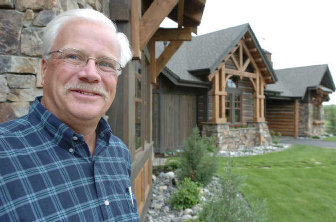
THOMPSON FALLS, Mont. — Paul Chambers’ quarry at the base of the Cabinet Mountains is a hard-rock bazaar. Choose your look: Smooth slabs? Stackable stones? How about some football-size rock ornaments?
In the hands of designers, the rock will become garden tables, waterfall spillways, rustic fireplaces or exterior facades. Chambers and his customers see those and more in the stone his crew extracts and moves to the outdoor showroom.
He is in a growth industry. State records in Montana show the startup of 100 small quarries in the last seven years. Robust construction in parts of the West and a design trend toward stone in houses, commercial buildings and landscaping largely get credit for the surge.
“There is an increasing interest in longevity and in good, simple materials,” said Bill Valentine of the American Institute of Architects. “In general, stone fills that bill.”
Robin McCulloch, research mining engineer at the Montana Bureau of Mines and Geology in Butte, put stone in his home’s interior.
“In a land of cookie-cutter houses, Sheetrock and paint, there’s some individualism that comes with rock,” McCulloch said. “Each rock is different from the last one. It would be impossible to build 30 houses, with stone, that look the same.”
As construction material in the United States, rock has seen a rebirth during the past five to seven years, said Thomas Dolley, commodities specialist for the U.S. Geological Survey.
Domestic production of what the industry calls dimension stone — distinguished from crushed rock — rose about 19 percent between 2001 and 2005, the USGS found. It predicts growing demand for rock during the next five years and reports substantial imports, with Italy the leading source.
There were about 35 producing states in 2005. Indiana led production, followed by Wisconsin, Georgia, Vermont and Massachusetts.
Montana stone includes the Thompson Falls area’s quartzite and shale, and in some other places, sandstone.
Chambers, who ships part of his rock and uses some in Thompson Falls houses that he builds, said Montana has a mystique that is part of the market appeal for his stone. He finds the state’s name a boost. People associate it with ruggedness and authenticity, he said.
At his Montana Solid Rock Quarry, Chambers has rock-washing equipment and a scale capable of weighing up to 20,000 pounds.
“At the low end, all (the work) really requires is a flatbed truck, a strong back and a crowbar,” said Warren McCullough, a bureau chief for the Montana Department of Environmental Quality, which regulates rock quarries. “It goes up from there.”
Montana has quarries where rock is blasted, and simpler enterprises that put people on private ranches to pick stones from the ground.
DEQ inspectors go out to check on a rock operation and find others they did not know about, McCullough said.
Regulations aim to control environmental effects such as the disturbance of streams and wetlands. Large proposals require environmental impact statements.
Quarry operators are not removing the kind of rock that could bring acid-mine drainage, said Patrick Plantenberg, reclamation specialist for DEQ. They may not mine below the water table, nor within 100 feet of streams.
The quarries have not drawn much environmental controversy in Montana, Plantenberg said. The relatively few complaints have come from “people upset with the visuals — it’s going to look like a quarry — and people concerned about dust,” he said.