
U.S. softens tone with China

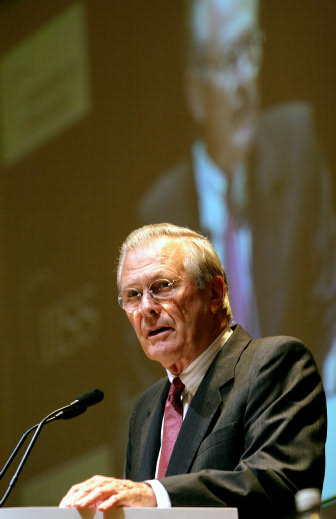
SINGAPORE – U.S. Secretary of Defense Donald H. Rumsfeld struck a conciliatory tone toward China Saturday, saying he was encouraged that Beijing was on a path toward being more transparent in its military intentions.
His remarks, at an annual gathering of Asian defense ministers here, were a significant departure from his strong rebuke of Chinese military spending at the same conference a year ago. He used the occasion then to warn that Beijing’s obfuscation on its strategic ambitions threatened regional stability.
The change in tone comes amid renewed Bush administration efforts to get Chinese agreement on a diplomatic course that could lead to U.N. sanctions against Iran for its refusal to submit to international inspections of its nuclear program.
Rumsfeld insisted his remarks were not tied to the administration’s new initiatives regarding Iran, and denied there was any shift in administration policy. “I didn’t notice any tone change,” he told reporters.
But unlike last year, where he devoted the bulk of his remarks to China’s attempts to upgrade its weapons technologies, Rumsfeld’s address Saturday mentioned China only briefly and in much more muted tones.
In response to 45 minutes of questions from Asian government officials and academics following the address, he was even more conciliatory. He said China was increasingly engaged with the international community, a trend he believed would lead Beijing to be more open with its strategic intentions in order to encourage continued economic investment.
“I’m encouraged that’s the path we’re on,” he said. “It’s a constructive path.”
A senior Pentagon official traveling with Rumsfeld said the shift in tone from a year ago was intentional, but said the change was due only to Rumsfeld’s desire to prevent bilateral issues with Beijing from overshadowing other regional security issues.
“He didn’t come here to belabor the issue again,” the official said. “He did not want this to dominate the issues here.”
Although Rumsfeld repeated his desire to see China further “demystify” its military intentions, he also went out of his way to say he did not believe Beijing would use force in Taiwan, long the thorniest defense issue in U.S.-Chinese relations.
“They say they see a world where Taiwan and China are one on a peaceful basis,” he said. “I take them at their word.”
The Pentagon has issued a series of reports in recent months that cast a more skeptical eye toward Beijing’s defense efforts.
Last month, in its annual report to Congress on China’s military power, the Defense Department said U.S. analysts were surprised by the pace and scope of China’s military modernization program.
It said the advances were aimed at the Taiwan Straits as well as “other regional contingencies” such as potential conflicts for natural resources.
In recent months, China has joined Russia in resisting U.S.-led efforts to impose U.N.-backed sanctions on Iran for resuming its nuclear program. On Thursday, however, both countries joined the U.S. and three leading European powers in agreeing to a package of incentives and penalties it would present to Tehran, the Iranian capital, as an incentive to suspend its nuclear program.