
Vanguard role
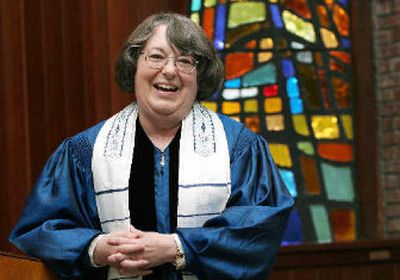
TINTON FALLS, N.J. – Sally J. Priesand, the first U.S. woman rabbi, arrived at Jewish seminary nearly 40 years ago determined to fulfill her dream to become a teacher of her faith.
Many people thought she came for a different reason.
“I think at first they thought I came to marry a rabbi rather than be one,” says Priesand, chuckling as she sits in her synagogue office, a space decorated with awards she’s received since her 1972 ordination. “So they didn’t take me all that seriously.”
Now as she prepares to retire more than three decades later, Priesand (pronounced PREE-sand) is widely seen as a role model who has helped change contemporary Judaism.
Since she was ordained in the Reform movement, nearly 1,000 women have become rabbis. The Reconstructionist movement ordained its first female rabbi in 1974, and the Conservative movement followed in 1985.
The Orthodox movement does not have female rabbis.
Priesand, 59, downplays her accomplishment, saying that she didn’t intend to be a pioneer. She credits Nelson Glueck, the late president of the Hebrew Union College-Jewish Institute of Religion, with championing her cause and ironing out problems so she could concentrate on her studies.
“In some cases it was very difficult for professors who were accustomed to teaching only men … to suddenly have a woman in the class, and often they would start, ‘Gentlemen, and lady,’ ” Priesand says.
During the 1920s, the Reform movement ruled that there was nothing in Jewish law forbidding women from becoming rabbis – but that it represented such a break from Jewish custom, people might not be ready for it, according to Rabbi David Ellenson, the current president of Hebrew Union College-Jewish Institute of Religion.
“Sally Priesand was a genuine innovator in American Jewish life and in Jewish history,” says Ellenson, whose school graduated 23 women in a combined class of 42 at seminaries in Cincinnati, New York and Los Angeles this spring.
“Her decision to study for the rabbinate paved the way for the inclusion of half the Jewish population.”
Former seminary President Glueck arranged for Priesand to tour the country the year before her graduation, speaking at congregations and at Jewish organizations so that people could get used to the idea of a woman on the “bima,” the altar in a synagogue.
Still, there were problems for Priesand.
After graduating, she took a position at the Stephen Wise Free Synagogue in New York City as an assistant rabbi but left after seven years because she believed her gender was keeping her from becoming the senior rabbi.
Priesand then served as the rabbi at a temple in Elizabeth, N.J., a part-time position, and was chaplain at a hospital in Manhattan. But it took her two years to find a full-time rabbi position, this time at the Monmouth Reform Temple in Tinton Falls, where she’s been for the past 25 years.
When she arrived at Monmouth, a synagogue of about 365 families, many in the congregation, including Priesand herself, assumed it would be a steppingstone to a bigger, more prestigious assignment.
But Priesand eventually chose to stay at the temple, in a small town on the Jersey Shore, realizing that while a bigger congregation might be a feather in the cap for her gender, she enjoyed the job she had.
“There was a time when most of the things that I did, I made decisions as to what was best for women in the rabbinate, not necessarily what was best for me, because everyone judged the whole idea of women in the rabbinate by what I did and how I acted,” says Priesand, who decided to remain single because of the around-the-clock demands of her calling.
She says that, while she was growing up, God was always seen as a “father” and “clearly male.” But children today have many different images of God, some masculine and others feminine, and Priesand says that’s partly the result of having women in the rabbinate.
Despite progress, she knows there is work to be done. Few women lead large congregations, and many of the highest-ranking positions within the Reform movement are held by men.
As a rabbi, Priesand is careful to have a good mixture of men and women in panels or discussions to reflect the makeup of the congregation. She wants girls to see opportunities for themselves within the synagogue, while not alienating men.
After she finishes work on June 30, Priesand says she’ll go away for six months to give the new rabbi – a man – a chance to establish himself. During that time, she’ll attend services at other nearby temples before taking up residence as the Tinton Falls rabbi emerita.
She will be missed by her congregants, who speak glowingly of her ability to deliver a sermon, her dancing around the bima, her desire to try new ideas and the sheer dedication she brought to the job.
“I was from an Orthodox background, so it was very unusual to see a woman performing as a rabbi,” says Karen Karl, a temple member for 15 years.
“It was the first time I ever held a Torah and said the blessing. This was where I truly connected as a Jew, with her. She’s a unique individual.”