
Building for the future
Sure, papers outlining the basis for an invisibility cloak seem out of place in the journal Science. But there they were recently, plain as day, below the understated titles “Controlling Electromagnetic Fields” and “Optical Conformal Mapping.”
Researchers say invisibility is only the most headline-grabbing of potential applications in the emerging field of metamaterials.
Here are some more: DVDs that hold more than 10 times the data of even the next-gen Blu-ray and HD-DVD discs, ultrasound with super-fine resolution capable of detecting disease in unborn babies, a microscope powerful enough to see inside human cells.
“There’s this growing realization that we can get more out of materials than we thought,” says David R. Smith, a Duke University associate professor of electrical and computer engineering. “It makes the prospects for something as seemingly science fiction or outlandish as invisibility scientifically feasible.”
For a primer on the metamaterial revolution, the Associated Press talked to Smith, Xiang Zhang, a mechanical engineering professor at the University of California at Berkeley, and Costas Soukoulis, a senior physicist at the U.S. Energy Department’s Ames Laboratory in Iowa.
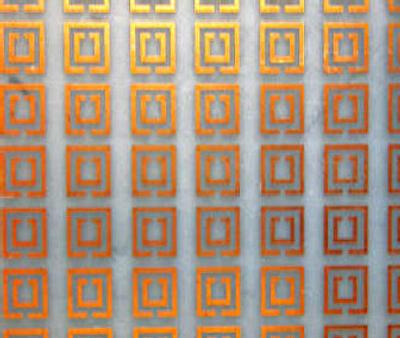
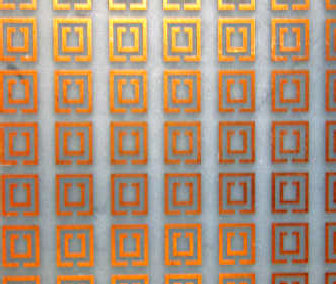
How they work: Metamaterials are artificially created substances that scientists essentially tune to respond to electromagnetic waves in ways that natural substances do not. “You replace the atoms and molecules of the actual materials with what look like micro- or nano-circuits. They look like little loops and wires,” says Smith. “It’s an architecture of the material that creates new properties that its parent material doesn’t have,” according to Zhang.
Left-handed waves?: The key innovation in metamaterials is the creation of a negative refraction index. It was first imagined by a Soviet physicist in 1968, but didn’t become reality until 2000. Here’s how that works: All natural materials refract light or electromagnetic radiation to the right at different angles and speeds. Negative refraction in metamaterials bends the light or radiation to the left. The change allows increased resolution in optical lenses, among other things. “It’s like rewriting electromagnetism,” Soukoulis says. “Snell’s law (on refraction of light) is going to be different; a number of other laws are going to be different.”
Superlens: Zhang last year demonstrated what he called a Superlens, which allows never-before-seen detail by essentially recovering light waves that have traditionally been lost in lenses. “In a regular lens you can transmit only part of the spectrum of the waves,” he says. “One type of waves cannot pass through to the image. If you can view the lens made by metamaterial, it has the capability to enhance or amplify this wave … then the image has a much sharper resolution.”
Future uses: Zhang, who also recently demonstrated acoustic metamaterials, said he is working toward a more refined Superlens that would be as revolutionary as the optical microscope. “This will enable the next level of the biology revolution,” he said. “With this new technique, we hope it will enable a total understanding of how the biological machines inside a cell works.”