
Insurance limbo delays Katrina rebuilding

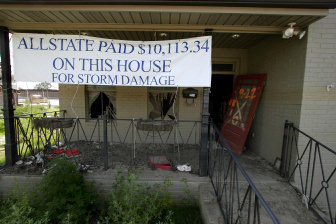
NEW ORLEANS – The owners of the sagging, flood-stained house aren’t in. Above the front door, a banner explains their absence – and the lack of progress: “Allstate paid $10,113.34 on this house for storm damage.”
Like the home next to it and the one after that, the house was disemboweled nine months ago by Hurricane Katrina. The force of the gushing water punched the refrigerator into the kitchen wall, and it still sits leaning through the house’s broken rib cage. Inside, mud has hardened into a crusty carpet, covering a designer sofa and a leather swivel chair.
“I want people to drive by my home and decide for themselves: Could I repair this for $10,000?” asks Eric Moskau, the home’s exiled owner who had more than $1.2 million in coverage on his 3,000-square-foot home.
Behind the sign he hung from his porch is a story all-too-common in this once-posh neighborhood of pummeled homes: Even New Orleans’ affluent homeowners, who thought they had done the right thing by properly insuring their investment, are finding that technicalities are keeping them from securing enough money from their insurers to rebuild.
The insurance industry says it has settled more than 90 percent of its Hurricane Katrina claims.
But consumer advocates say insurers settled numerous claims for only a fraction of the actual damages, using numerous exclusions to reduce payouts. Insurance modeling firm ISO estimates Louisiana had $24.3 billion in insured losses, but the state Department of Insurance says only $12.5 billion had been paid out as of the end of April, the last month for which figures are available.
Without enough money from their insurers to rebuild, homeowners are left with two choices: Give up and leave or rebuild by hand, using their savings to pay for labor and materials.
“It’s basically self-insurance,” said Moskau, who had what he thought was plenty of coverage on his two-story house but who now is among those who have abandoned their homes on once-stylish Bellaire Avenue.
Exactly 63 sagging, warped and mud-filled homes separate Moskau from the nearest neighbor who is repairing his home.
After last year’s floodwaters receded, politicians initially blamed residents of this below-sea-level city, claiming too few had purchased federal flood insurance on top of their homeowners policies, which cover only wind damage.
Yet, an analysis by the office of Donald Powell, the Bush administration’s Gulf Coast recovery czar, found few communities were better-insured against flooding than New Orleans: Two out of three homes there had flood insurance, 13 times more than the national average of 5 percent. The New Orleans figures also are far more than in many other communities prone to flooding. For example, Harris County, Texas, has one of the highest rates of repetitive flooding in the nation, but only a quarter of homeowners there have flood coverage.
Moskau, a well-to-do real estate appraiser, thought he had taken every precaution: He had the maximum federal flood insurance of $250,000. But when the government issued that check, it was issued in two names: Moskau’s and his bank’s. His bank applied the check to his $600,000 mortgage, leaving him with an outstanding note of $350,000 and no money for repairs.
According to a spokesman at the Federal Home Mortgage Corp. (Freddie Mac), which over the last five years has bought more than $7.5 billion in mortgages in Louisiana, banks are required to put insurance checks into an escrow account, disbursing the funds as repairs are completed. An exception is allowed if the home is in an area where rebuilding has been prohibited; in that case, the insurance check can be applied to the outstanding mortgage, said spokesman Brad German.
Flanking one of New Orleans’ buckled levees, much of Bellaire Avenue still is in rebuilding limbo.
Moskau’s house, like most on Bellaire, swallowed less than 6 feet of water. It destroyed the first floor but not the second. The second floor, however, got wet, too. Water seeped in through the vents, pushed in by the hurricane’s 140 mph winds, Moskau said. The roof also was damaged, and windows were punched out – damage, says Moskau, that should be covered under the wind-only policy. But Allstate told him the damage all was due to flooding.
“I agree that the first floor flooded. I used to be an insurance adjuster and I know the rules, so I didn’t expect Allstate to pay me for that. But the second floor clearly didn’t (get flooded). So shouldn’t I at least get 50 percent of my policy?” asked Moskau.
The chief executive officers of State Farm Insurance Co. and Allstate Corp., the nation’s No. 1 and No. 2 insurers, declined to discuss specific claims. Together, they control half the insurance market in Louisiana.
“When you track our claim satisfaction, it is very high in those areas. Ninety-three percent to 94 percent of our Katrina claims have been settled,” said Allstate CEO Edward M. Liddy.