
Imagining heaven, hell
Belief in hell is going to you-know-where. And belief in heaven is in trouble, too.
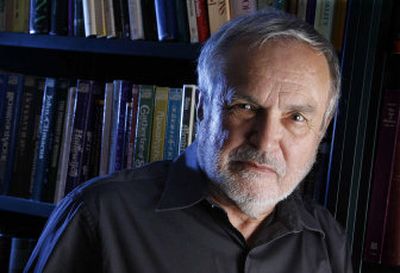
That’s the concern of some Christian thinkers, including Jeffrey Burton Russell. The emeritus professor of history at the University of California, Santa Barbara, is the author of the new book “Paradise Mislaid: How We Lost Heaven and How We Can Regain It” (Oxford University Press, $28).
Russell and other fretters aren’t impressed by fads like the sudden popularity of the girl’s name Naveah (heaven spelled backward) or polls that show most Americans believe in some sort of heaven.
The growing problem, they say, is that the way U.S. Christians conceive of both heaven and hell is so feeble and vague that it’s almost meaningless – vague “superstition.”
It’s “not that heaven is deteriorating,” Russell says. “But we are.”
Gallup reported in 2004 that 81 percent of Americans believed in heaven and 70 percent in hell. An earlier Gallup Poll said 77 percent of ever-optimistic Americans rated their odds of making heaven as “good” or “excellent.” Few saw themselves as hellbound.
“The percentage who say they believe in heaven has remained pretty constant the past 50 years, but what people mean by it has changed an awful lot,” Russell says.
Some people are so confused they believe in heaven but not God – “I suppose a New Age thing,” he says.
But if today’s notion of paradise is off base, and sentimental images of clouds, harps and cherubs are the stuff of magazine cartoons, then what’s the best way to think of heaven?
“For Christians, basically, heaven underneath all of the decorations means living in harmony with God and the cosmos and your neighbors and being grateful,” says Russell, who studied hell and Satan for 15 years before first turning his attention to heaven in his 1997 book “A History of Heaven.”
To Russell, it’s healthiest to see heaven as starting on Earth, not an existence that “suddenly happens when you die.”
What about hell and its fire and brimstone?
“There is a tendency to overdramatize hell in order to get (it) across to people,” he says, but it’s simply “the absence of God, the absence of heaven.”
“Heaven has gradually been shut away in a closet by the dominant intellectual trends,” Russell writes.
Likewise with hell: He cannot remember the last time he’s heard that unhappy subject treated in church or in religious literature.
What happened? Russell’s book is largely a heartfelt appeal against “physicalism,” the modern claim that knowledge comes only through the physical senses and empirical science.
Such an outlook is arrogant and unproveable, he believes, because it ignores humans’ moral sense and the supernatural – including heaven and hell.
Among Protestants who share Russell’s angst, perhaps the most outspoken is the Rev. David F. Wells of Gordon-Conwell Theological Seminary in Massachusetts. He has spent years bemoaning the erosion of Christian teaching, through books like last fall’s “Above All Earthly Pow’rs: Christ in a Postmodern World” (Wm. B. Eerdmans, $25).
Wells contends that Western Christianity is on the defensive against religious skepticism, secularism, materialism and consumerism.
He says that when Christian truth collides with the dominant cultural belief, promoted by psychology – that individuals should choose whatever they want – then “something has to give. And in our world today, in America and much of the West, what is giving is Christianity.”
That includes the faith in “ultimate right and wrong” that undergirds heaven and hell, Wells says.
So, many who say they believe in heaven are “projecting from their very best therapeutic experiences into eternity,” not meeting God “on his own terms,” he says.
A related question is who enters heaven. On that, Americans are predictably expansive.
A Newsweek/beliefnet.com poll last year asked, “Can a good person who isn’t of your religious faith go to heaven or attain salvation?” Fully 79 percent said yes, with somewhat lower percentages among evangelicals and among non-Christians.
In Catholicism, the Second Vatican Council (1962-65) declared that people who do not know the Christian gospel but sincerely seek God “can attain to everlasting salvation.”
The church decided that requiring explicit Christian faith was too pessimistic, says U.S. theologian Cardinal Avery Dulles, writing in First Things magazine.
But now, he cautions, “thoughtless optimism is the more prevalent error,” with many Christians mistakenly assuming that “everyone, or practically everyone, must be saved.”
Christians are permitted to “hope that very many, if not all, will be saved,” Dulles says. Still, he adds, the New Testament teaches “the absolute necessity of faith for salvation” and says that each of us faces just two possibilities, either “everlasting happiness in the presence of God” or “everlasting torment in the absence of God.”