
Thieves try to cash in on copper
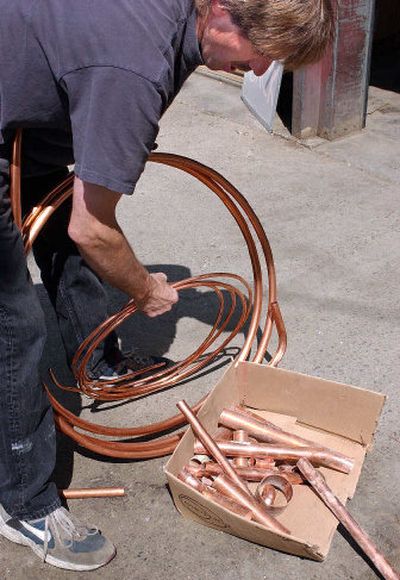
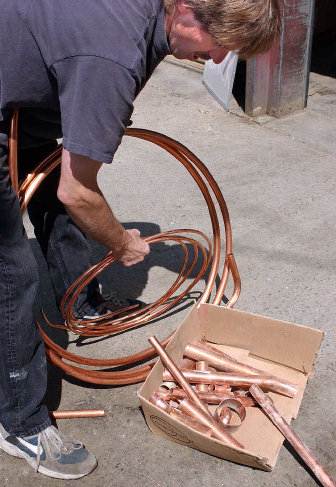
It’s almost like finding dollar bills hidden in the wall.
At more than $3 per pound, copper has become a hot target for thieves who are breaking into construction sites, pulling it out of batteries and even risking death by cutting into electric lines that cost utilities thousands to repair.
Copper “is not really identifiable,” said Rich Clark of Clark’s Recycling. “You have to prove it’s not theirs, which is hard to do.”
Someone stole 90 to 100 pounds of copper as well as tools from his operation in March. Even though he said he has a pretty good idea who took it and recycling companies are constantly watching for suspicious copper, one load of scrap metal is often hard to distinguish from another.
Since the beginning of this year, metal thefts have been reported by Modern Electric, Avista and even Union Pacific Railroad, which reported in April that more than 3,000 feet of cable had been stolen between Apache Pass and South Dishman-Mica Road.
Police and victims say the thefts have become more brazen since the price of copper prices began rising about a year ago, driven by heavy demand in China.
“I don’t think it’s ever been this high,” Clark said. “I’ve been doing this for 20 years, and it’s never been close.”
Construction sites are frequent targets.
A 100-foot roll of copper pipe that used to cost about $200 now sells for about $650, said Clay Johnson of Johnson Brothers Construction Inc.
In Spokane, which requires that copper pipe run to water mains, even the section of pipe that connects to the main is a target.
“Before I can pour concrete, somebody’s stolen whatever copper is sticking out of the ground,” Johnson said.
He even returned to one job site to find the foundation flooded because someone cut away pipes with water running through them.
Builders lock up batteries, pipe, wire and other material.
But it’s often impossible not to leave some metal in the house at night, and police are asking neighbors to keep an eye out for suspicious people around construction sites.
“If they’re not wearing construction clothing at 7 o’clock at night, give us a call,” said Sgt. Dave Reagan of the Spokane County Sheriff’s Office.
If a homeowner thinks a theft could be in progress, police say 911 is the best number to call.
Drug use drives most copper thefts, Reagan said.
Clark’s Recycling and other places require ID and ask recyclers whom they work for before accepting metal. They also keep an eye out for marked and unusual scrap that police alert them may be coming their way, but some criminals have gotten just as crafty.
“We’ve even had them come in with a company hat on before,” Clark said.
Recyclers keep in touch with each other, Clark said, and sometimes are able to recover stolen material.
Regan said someone recently went to a nearby recycling center and tried to sell thousands of dollars worth of stolen, heavy-duty extension cords used for cranes.
Workers there identified the metal as stolen and returned it to its owner, but by then it had been cut into 2-foot pieces, Regan said.
The Sheriff’s Office may push for a state law similar to the one that governs pawn shops to better track recycling, Reagan said. Recyclers would have to require identification and keep records of what they take in.
Businesses can protect themselves by keeping storage areas well lighted, locking up materials and keeping stocks of copper to a minimum.
Other targets, though, are harder to protect. Recently someone made off with power lines from poles near Loon Lake, Wash.
“If they keep stealing power lines off poles, that’s going to be a problem that solves itself,” Reagan said.