
Floating green helps pay for Harrison docks
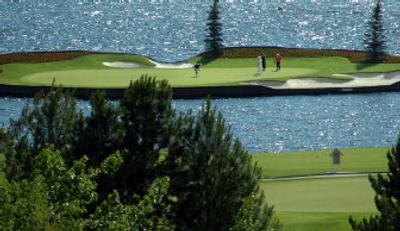
BOISE – Lease fees from the world’s first floating golf green are helping pay for improved boat tie-ups and public docks in Harrison.
The multi-year project to upgrade Harrison’s public dock, which mostly is being funded by state grants, got a final boost toward completion last week when Kootenai County got state approval to tap into $30,000 from floating green lease fees. A portion of the floating green lease payments each year go to Kootenai County for boating improvements on Lake Coeur d’Alene, and have since the unique 14th hole was added to the Coeur d’Alene Resort Golf Course in 1990.
But the money, about $10,000 a year, hasn’t gone far, funding only a few county projects. The county’s fund had a $132,330 balance on April 30.
“It doesn’t grow real fast in the big picture,” county Commissioner Rick Currie said.
Currie said the county has tried to build up the fund so it could pay for acquisition costs for new public boat facilities. “But with the price of property around the lake, it doesn’t move up as much as (land value) inflation does,” he said, “so this is a good usage for it. … You can’t do a lot with that money. … When the opportunity presents itself to complete a project, we’re going to.”
The county has been trying to get the Harrison dock project done for the past four or five years, he said. State grants from boat registration funds have paid for most of the project, along with city and county matching funds. The project initially was estimated to cost about $183,000. But increasing materials costs have pushed the price tag up to nearly $213,000, leaving a shortfall – one that the floating green funds filled.
“It’s a good place to spend ‘em,” Currie said.
The Harrison dock project includes installing moorage docks, decking, railings, a handicap-accessible pier and gangway, new restrooms and improvement of a breakwater. When completed, the facility will have 19,700 square feet of moorage space for day-use, overnight and transient boat tie-ups.
“It’s very important. The boating public is expanding on a daily basis, and the Harrison facility is one of the premier facilities on the lake for the public to use and have access to,” Currie said.
The state Land Board unanimously approved the expenditure last week. In May, it had approved another $12,000 in floating green funds for the project, and $45,000 for the Third Street Dock breakwater project.
The only other project funded in recent years was paying part of the cost of a land acquisition at Cougar Bay. There, the floating green funds paid $1,500 a month toward $5,000 monthly payments for life to the landowner, with the U.S. Bureau of Land Management picking up the rest of the cost. Upon the owner’s death 18 months later, the land became public.
Currie said the public ended up with a multimillion-dollar piece of property as a result.
When Hagadone Hospitality Corp. first negotiated its lease to use state-owned waters for the floating golf green back in 1988, no one knew if the first-ever floating green would be successful. In negotiations with then-Gov. Cecil Andrus and the Land Board, the company agreed to lease payments of $15,000 a year or 2 percent of gross receipts from greens fees, whichever was more.
The lease also gives Hagadone a 20 percent rebate on each year’s rent for keeping Sanders Beach open to the public for 500 feet east of Jewett House, and directs another 20 percent of each year’s rent to a special county waterways fund for boater improvements to Lake Coeur d’Alene. County commissioners must seek Land Board approval for expenditures from the fund.
In 1991, commissioners submitted a list of $55,190 in dock improvements they wanted to make with the fund – but it only generated $3,000 that year.
In 1996, the county got $7,986.
In 1998, as the floating green lease came up for renewal, Hagadone officials protested that they had thought they would pay about $15,000 a year but were paying close to twice that, in part because higher than expected maintenance costs for the floating green forced them to charge higher greens fees.
They asked for a rent cap, but the state refused. Instead, the state added a clause to the lease to limit increases in gross receipts, for the purpose of calculating rent payments, to the amount of increase in the consumer price index each year.
In 2004, at Hagadone’s request, the state renewed the lease for 10 years with an additional 10-year option to renew, as the company embarked on a multi-year, $75 million expansion and development at the golf course. Terms and conditions remained the same.