
‘When I’m 64’
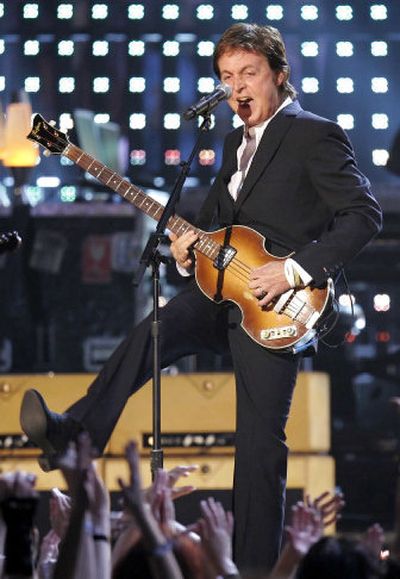
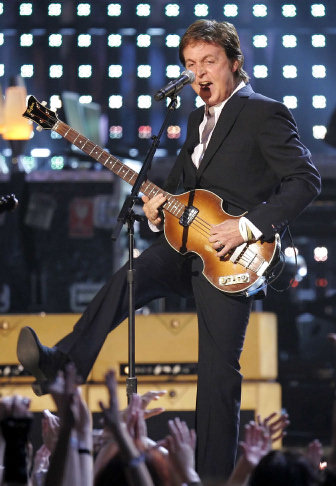
He’s not losing his hair, though color seems to be an issue.
He does have grandchildren, though no Vera, Chuck or Dave.
And given the recent upheaval in his personal life, it’s unclear who’ll feed him – though there’s no doubt he’ll be taken care of.
Yes, the cultural alarm clock that Paul McCartney set 39 years ago is ringing. The man who sang “When I’m Sixty-Four” in 1967 turns 64 today.
“I do remember that on the (song’s recording) session, we all figured out it would be 2006 when Paul was 64,” recalls Beatles engineer Geoff Emerick, “and we had a good laugh about that and wondered what we’d be doing.”
That McCartney is reaching the age that he whimsically imagined so long ago is an unavoidable milestone, a ready-made occasion for comparing snapshots, then and now, of both the singer and his contemporaries. (“You’ll be older, too,” after all.)
It’s also the inevitable moment when the words of the young man are shoved into the face of the old – or let’s just say older – man.
At least McCartney’s tongue-in-cheek portrait of his dotage was affectionate enough that it shouldn’t be too tough for him to swallow. Fellow ‘60s icons Pete Townshend and Mick Jagger have had to choke on the strident, aging-averse declarations of their younger selves.
Townshend has become a walking ironic counterpoint to the classic line he wrote for the Who’s “My Generation”: “I hope I die before I get old.”
As for Jagger, the wiry Stones frontman was famously quoted as sneering, “I’d rather be dead than singing ‘Satisfaction’ when I’m 45.” He was 62 when he sang it at this year’s Super Bowl.
McCartney didn’t equate old age with death in “When I’m Sixty-Four,” but it’s nonetheless revealing in the way it views the autumn years from a spring chicken’s perspective.
The ex-Beatle has told interviewers he wrote the song when he was “about 16” – placing it in the late 1950s, eight or so years before the Beatles finally recorded it for their landmark album “Sgt. Pepper’s Lonely Hearts Club Band.”
It’s a vaudeville-style toe-tapper in which the singer wonders whether his sweetheart will still be around to dote on him and to share a mundane life when he’s “older, losing my hair, many years from now.”
“Doing the garden, digging the weeds/Who could ask for more?” he asks with a straight face, as if that prospect really excited young people back then. “Will you still need me/Will you still feed me/When I’m sixty-four?”
That question rings bittersweet for McCartney these days. His first wife, Linda, died of breast cancer in 1998 after almost 30 years of marriage. He remarried a young activist named Heather Mills, but their separation was announced last month.
When the Beatles finally recorded this “rooty-tooty” song (as McCartney called it), it was an anomaly both on the “Sgt. Pepper” album, where it’s easily the least psychedelic track, and in the larger rock world. You didn’t hear other rock bands recording songs driven by multiple clarinets, though McCartney’s fascination with the baroque arrangements on the Beach Boys’ 1966 classic “Pet Sounds” is felt here.
Emerick, who details his experiences recording the Beatles in his new book “Here, There and Everywhere” (Gotham, $26), recalls speeding up McCartney’s voice to make it sound more youthful.
The engineer said he thinks McCartney finally decided to record “When I’m Sixty-Four” for “Sgt. Pepper” after pulling off the glorious string arrangement of “Eleanor Rigby” on the Beatles’ previous album, “Revolver.” Another frequently cited theory is that McCartney was paying tribute to his father, Jim McCartney, who turned 64 in 1966.
In any event, there was something audacious about the Beatles recording such a song at the height of their popularity.
” ‘When I’m Sixty-Four’ stood out when it came out as a blatantly non-rock ‘n’ roll tune by the most famous rock ‘n’ roll band in the world,” says Boston-based rock critic Milo Miles.
“Also, the whole youth culture was so potent at that time that the idea of the Beatles singing about being 64 was part of the mind-blowing aspect of it.”
The tune may actually be more popular among non-fans than Beatles die-hards. Looking back, some critics have derided the song for being a harbinger of the cloying, wink-wink quality that would infect some of McCartney’s subsequent Beatles contributions and his solo career.
Emerick said he didn’t think John Lennon liked it at the time, a sentiment the late Beatle confirmed in his 1980 interview with Playboy: “I would never even dream of writing a song like that.”
Even superfan Terri Hemmert, who hosts “Breakfast With the Beatles” on a Chicago radio station, calls it “a novelty song. … It’s not one of their great songs, but it’s a fun song.”
Still, it’s become a standard, a tune you routinely encounter and probably hum along to. A few years ago Julian Lennon, John’s first son, even sang it on an insurance commercial.
Now the song has become a touchstone for Baby Boomers realizing they’re catching up with an age that used to seem so distant.
“When I was a kid, 64 was old,” said Mark Lapidos, 58, founder of the Fest for Beatles Fans. “(Now) the Baby Boomers are in their late 50s or turning 60; we don’t consider that old. Sixty-four was goodbye. Now it’s just getting started.”
Yet turning 64 still feels significant – particularly in the case of the Beatles, given that Lennon and George Harrison are no longer around.
“It’s kind of poignant,” says Hemmert, “because only two of the four got that far, and 64 isn’t that old.”