
Iran at top of agenda for Bush, EU leaders

WASHINGTON – President Bush heads to Europe today to shore up a frayed alliance that’s nonetheless trying to pull itself together to confront the potential threat of a nuclear-armed Iran.
Iran tops the agenda for Bush’s meeting with European Union leaders in Vienna, Austria. While Bush remains unpopular overseas, diplomats from both sides of the Atlantic agree that relations between the United States and Europe have improved dramatically since their bitter divisions over the U.S. decision to invade Iraq in 2003.
Government officials and outside experts agree that Bush and his European counterparts now recognize that, despite their differences, they need each other. Sort of like the Rolling Stones, according to John Hulsman, a foreign-policy specialist at the Heritage Foundation, a conservative Washington research center.
“Think of Keith Richards when he says to (Mick) Jagger, ‘This thing is bigger than both of us.’ That’s where we are,” Hulsman said. “The kids want to save the marriage even though the love is gone.”
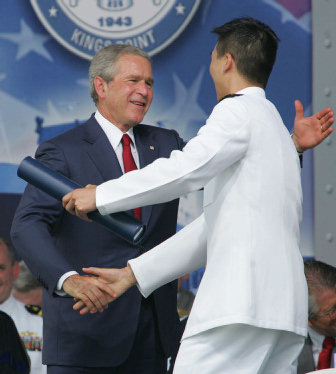
The president devoted most of his commencement address Monday at the U.S. Merchant Marine Academy in Kings Point, N.Y., to extolling the partnership with Europe as essential to securing global peace and prosperity. He noted pointedly that “America and Europe are united on one of the most difficult challenges facing the world today: the behavior of the regime in Iran.”
While emphasizing that America and Europe are united in hoping “to solve this problem diplomatically,” Bush warned Iran that failure to resolve the budding conflict over its nuclear-research program “will result in action before the (U.N.) Security Council, further isolation from the world and progressively stronger political and economic sanctions.”
For all the president’s emphasis on U.S.-European unity, however, divisive issues remain.
While there’s widespread agreement that Iran shouldn’t be allowed to acquire nuclear weapons, some nations remain reluctant to impose tough sanctions on the Islamic republic, and it isn’t clear how many of them would support pre-emptive military action.
Bush will prod Europeans to do more to help in Iraq, because while nations around the world have pledged $13.5 billion in aid, they’ve delivered less than $4 billion.
“Pledging is great, and makes some headlines in the newspapers, but what we need is those pledges to be turned into real dollars,” national security adviser Stephen Hadley said.
The Europeans also will challenge Bush on the treatment of terrorism suspects at the U.S. naval base in Guantanamo Bay, Cuba, and alleged military atrocities in Iraq. But Hadley said Bush had no intention of complying with European demands to close the Guantanamo detention facility.
“The president has spoken to those issues . … There’s not a whole lot new to be said,” Hadley said.
Chilly as that may sound, European officials say Bush has dropped some of the swagger of his first term, when he showed little regard for their views.
Over European objections, Bush abandoned the Kyoto treaty on global warming, abrogated the Anti-Ballistic Missile Treaty, declared the right to launch pre-emptive war and invaded Iraq without approval from the United Nations.
Austrian Ambassador Eva Nowotny said in an interview that the “vastly improved” relationship turned a corner at the last U.S.-EU summit, in February 2005, when Bush reached out to Europeans and called for “a new era of trans-Atlantic unity.”
Hungarian Ambassador Andras Simonyi agreed: “Obviously, there’s been a change in attitude from the Bush administration. Europe and America have to hold hands.”
Both sides wanted a fresh start.
“It was a shift born of pragmatism. The United States was up to its eyeballs with trouble in Iraq,” said Charles Kupchan, professor of international relations at Georgetown University.
“On the other side of the Atlantic, you had the realization that the rift with the United States was very harmful, deeply divisive.”