
Risk to pets rises with temperature
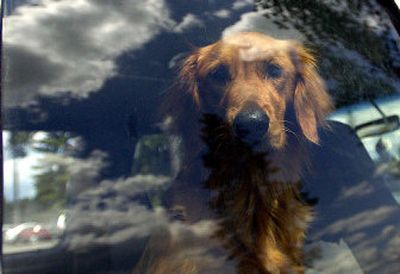
With summer starting today and temperatures on the rise, people can suffer from a variety of heat-induced afflictions. But add a coat of fur, the inability to speak and a locked car, and the combination can turn deadly.
The temperature in a parked vehicle on a hot day can climb above 110 degrees, posing a serious threat to pets in just minutes, said Danette Roberts, a veterinarian at Kootenai Animal Hospital in Post Falls. “Their internal body temperature gets so high that it’s hard to reverse that,” Roberts said.
A dog’s average body temperature is between 101 degrees and 102.5 degrees. Brain damage can occur at 106 degrees, Roberts said. In the past few weeks, Kootenai Animal Hospital has treated three dogs suffering from heat exhaustion; one dog died, she said.
“In my experience, I’d say it is at least a 50 percent mortality rate,” she said.
Animal owners should be aware of the symptoms of heat exhaustion, Roberts said. Diarrhea, heavy panting, excessive drool, staggering or lethargy can indicate an animal is in distress, she said. Treatments for heat exhaustion at an animal hospital include intravenous fluids, alcohol dabbed onto an animal’s footpads to help with cooling or even an ice bath to lower core body temperature.
If someone reports a dog closed up in a parked car, Kootenai County, Coeur d’Alene and Post Falls each have animal abuse response officers who respond.
Spokane County Regional Care and Protection Services and SpokAnimal C.A.R.E. also respond to many such calls, and can issue misdemeanor citations.
For Daryl Robertson, Coeur d’Alene’s animal control officer, the special summer events in town are his busiest times.
“If I’m busy with something else and I get an animal abuse call, I’ll go to those right away,” he said.
More often than not, the vehicle in question will be gone by the time Robertson arrives. But if not, he’ll stay with the animal to monitor its condition and try to contact the vehicle’s owner, even if that means paging them over a store intercom.
To enter a vehicle with the owner not present, Robertson must first get permission from police and have an officer on the scene. After he gains access, the animal can be impounded. The owner is left with an empty vehicle and a note saying where to find the pet, plus a brief description of how to avoid inadvertently cooking an animal in what can become an oven on wheels.
An animal owner could be cited with a misdemeanor, but only if that person intended to harm the pet or knew what he was doing would cause injury, said Frank Bowne, an officer with the Post Falls Police Department.
“The way the code is written, it’s somewhat vague,” Bowne said. “If you’re a reasonable person and you know what you are doing, you are going to be held accountable.”
Usually owners are gone for only a short time and don’t realize how fast a vehicle can warm up, Robertson said. On especially hot days, the thermometer Robertson takes along to reports of dogs locked in cars can exceed 120 degrees, even with a window cracked open.
If police do issue a ticket for a trapped animal, it’s usually for improper shelter or quarters – a $50 reminder that an animal needs a roof with three sides in a comfortable environment plus food and water.
As a general rule, if people need air conditioning while in the vehicle, it’s probably too hot to take along a pet, Robertson said.
“It gets hot way too fast for a dog,” he said. “As the summer progresses, it’s going to be a huge problem.”