
Thousands must decide today whether to take GM buyout offer
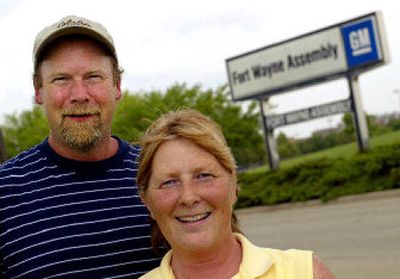

DETROIT — For some workers, the decision to take the General Motors Corp. buyout and run didn’t require much thought.
But as today’s deadline to sign the paperwork approaches, thousands of United Auto Workers union members nationwide are still agonizing over whether to stay with the company, retire early or take up to $140,000 to sever nearly all ties with the nation’s largest automaker.
Local union leaders say it’s not so much the numbers that are delaying the decisions. It’s the thought of ending a way of life.
“You put your name on that piece of paper, it’s like saying `my life is over with,”’ said Dennis Henry, president of a UAW local at the GM technical center in Warren, Mich. “You’re almost admitting that the best part of your life is gone. That’s what’s been working on a lot of the people here.”
As of last week, about 25,000 workers had decided to leave GM one way or another as the struggling company tries to shed 30,000 U.S. hourly jobs by 2008 as part of its restructuring plan. In March, GM announced that it would offer buyouts or early-retirement incentives to all 113,000 of its hourly employees.
UAW officials figure that at least 30,000 will end up leaving, letting GM reach its goal two years early. In addition, another 8,500 workers at Delphi Corp., GM’s former parts operation, already have signed up for similar offers, although their deadline is at least 45 days away. Some Delphi workers will return to GM under an agreement with the UAW.
The exodus is likely to further erode the UAW’s bargaining power, with the union losing more than 5 percent of its membership in the deal. Membership had been dropping even without the buyouts, from its peak of 1.5 million in 1979 to the current figure of just under 599,000.
But it’s good for GM, which will unload about $3 billion a year in annual payroll costs if 30,000 workers decide to leave, said Kevin Reale, research director for AMR Research, an industry consulting firm in Clarkston, Mich.
The smaller work force alone, though, won’t save GM, Reale said. “This just kind of gets them some relief. I don’t think it’s where they need to be.”
GM made $445 million in the first quarter of this year after losing $10.6 billion in 2005.
Reale said GM still has structural problems that include higher costs and less-efficient plants than its main Japanese competitor, Toyota Motor Corp.
At the GM assembly plant in Lordstown, Ohio, where 3,500 UAW workers make the Chevrolet Cobalt, 900 have decided to leave, and local union President Jim Graham expects 1,000 to sign up before the deadline. The number equals those on an entire shift at the sprawling plant and is nearly a third of the local’s membership.
While the plant will cut back its shifts to two from three, the departures mean many workers won’t see the friends they’ve made over the years at the factory, said Walt Duvernois, president of a 4,200-member local at seven plants in Flint, Mich., where about 1,000 workers are likely to leave.
“You’re almost closer to some of the friends at work than you are at home,” he said. “It’s just like a big family.”
GM plans to use workers from Delphi and laid off workers of its own, among others, to make up for any shortfalls in staff resulting from the buyouts.
The buyouts and retirements, workers say, also will damage the union.
“I think it will hurt your bargaining strength,” said Duvernois.
Gary Brown, who took an early retirement offer last month after spending 34 years at a GM foundry in Defiance, Ohio, said the buyouts will shrink the pool of workers paying dues to the UAW.
At its convention last week, UAW delegates approved transferring $50 million from the strike fund to help pay for union operations during the coming four years.
For Brown, 55, and other workers with a lot of seniority, taking early retirement was an easy decision.
Darwin Cooper, 59, who spent nearly 40 years at the Lordstown plant, said he’ll get nearly his full retirement benefits even though he’s stepping down about three years before he’s eligible for them.
“I actually planned three years ago to leave this year,” he said. “When this incentive package came out, it was just a bonus.”
Brown signed up for a package that adds about $550 a month to his retirement pay until he can get full retirement benefits one month after his 62nd birthday.
“This is more or less like me hitting the lottery,” he said.