
Ripeness sticker removes guesswork

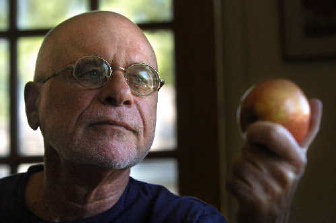
ALBUQUERQUE, N.M. – Squeeze it, smell it, poke it, shake it – there’s really no reliable way to tell whether the fruit you buy in the grocery store is ripe until you get it home and bite into it.
An Albuquerque psychologist-cum-inventor aims to change that.
Robert Klein’s two-man company, Redi Ripe, hopes to begin marketing, as early as next year, inexpensive stickers that change color when fruit is ready to eat.
Klein has been developing the thumbnail-size stickers with the help of a University of Arizona professor for several years and expects to test prototypes during Washington apple harvests this fall.
“It just drives you nuts,” Klein says of the supermarket produce-section guessing game that prompted his epiphany half a dozen years ago. “You get it home, and you still don’t know if it’s ripe or rotten. I just thought there’s got to be an easier way to tell if fruit is ripe.”
The project is backed by grants from the Washington Tree Fruit Research Commission and the U.S. Department of Agriculture.
Klein, who has a doctorate in psychology, has never taken a college chemistry class and, until recently, his exposure to agriculture was limited to trips to the grocery store. At 65, the Bronx native who moved to Albuquerque 30 years ago could have rested on his laurels.
Klein has run a preschool for emotionally disturbed children and worked at a local newspaper and now publishes popular guides to all the world’s beers.
Now his goal is permanence.
“I don’t expect this to make money in my lifetime. That’s secondary,” he says. “I want to get a patent.”
The company has a patent pending.
Klein’s frustration with inferior fruit led to some casual research, during which he zeroed in on ethylene, which is produced as fruits, vegetables and flowers mature. Ripening, and eventually spoiling, is determined by the plant’s production of ethylene, as well as the fruit’s exposure to ambient ethylene, which is commonly referred to as the “death hormone.”
Lacking the scientific knowledge to produce a device to detect ethylene concentrations, Klein e-mailed and called around to area universities and other institutions before finding a willing collaborator in Mark Riley, a University of Arizona associate professor of agricultural and biosystems engineering.
The two later hashed out a deal with the university allowing Riley to assist in the research, and later submitted a proposal to the Washington group, which gave them a grant to develop stickers that change color in reaction to ethylene released through the skin of fruit such as apples and pears.
Founded in 1969, the Washington Tree Fruit Research Commission funds about 150 proposals from scientists, growers and other innovators every year, said its manager, Jim McFerson. Its constituents include apple, pear, cherry, peach and nectarine growers. In Washington state, the tree fruit industry’s annual economic impact exceeds that of Microsoft and Boeing, topping $6 billion per year, McFerson says.
Facing increasing competition from Asia and elsewhere, growers are looking to new techniques and technologies to stay ahead in the labor-intensive industry.
“The one thing we know is that the consumer prefers a piece of fruit that is in good condition and tastes good,” McFerson says. “A key component of that is knowing when the fruit is ripe. Bananas tell you, but unfortunately, a lot of our fruits don’t.”
Though Klein says he originally envisioned the stickers on fruit at stores, the industry response has caused Redi Ripe to refocus, for now, on providing ways for farmers to monitor ripeness in fields and orchards by putting a few stickers on fruit on each plant or tree. The $1.7 billion U.S. apple industry loses $300 million annually to spoilage, according to the company.
Packing houses, which use temperature and other means to delay or hasten ripening of picked fruits, could also use the stickers, Klein said.
The stickers would cost pennies each, Klein said.