
Different view of science
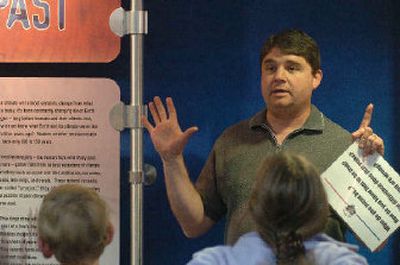
BOULDER, Colo. – Inside the flagship lab of the National Center for Atmospheric Research, a dozen home-schooled children and their parents walk past the offices of scientists grappling with topics from global warming and microphysics to solar storms and the electrical fields of lightning.
They are trailing Rusty Carter, a guide with Biblically Correct Tours.
At a large, colorful panel along a wall, Carter reads aloud from a passage describing the disappearance of dinosaurs from the earth about 65 million years ago.
He and some of the older students exchange knowing smiles at the timeline, which contradicts their interpretation of the Bible suggesting a 6,000-year-old planet.
“Did man and dinosaurs live together?” Carter asks.
A timid “yes” comes from the students.
“How do we know that to be true?” Carter says.
There’s a long pause.
“What day did God create dinosaurs on?” he continues.
“Six,” says a chorus of voices.
“What day did God create man on?”
“Six.”
“Did man and dinosaurs live together?”
“Yes,” the students say.
Mission accomplished for Carter, who has been leading such tours since 1988. He and the other guides counter secular interpretations of history, nature and the origin of life with their own literal reading of the Bible.
And they do so right at the point where they feel science indoctrinates young people: museums.
“Museums are the secular temples of our day,” founder Bill Jack says. “If you watch people walk in, especially in (Denver’s) Museum of Nature and Science, they fold their hands reverently, they speak in hushed tones, they don’t let kids touch.
“The kid says, ‘What’s this?’ Dad reads the sign, and they say, ‘Ooh, ahh.’ They worship the creature rather than the Creator.”
During a recent tour, Carter told a dozen children and their parents that abortion was an act of natural selection carried out by humans. Other tours suggest Hitler was playing his version of survival of the fittest by favoring whites.
“My contention is evolution kills people,” Jack says. “It’s not that evolutionists don’t have morality; it’s that evolution can offer no morality.
“Ideas have consequences. If you believe you came from slime, there is no reason not to, if you can, get away with anything.”
Around 100 groups book tours each year with Biblically Correct Tours, paying at least $100 minimum, or $5 per person. Popular stops include the National Center for Atmospheric Research complex, zoos and the Denver museum.
The idea isn’t unique. The 7 Wonders Museum at the Mount St. Helens volcano in Washington state says it is dedicated to “creation science studies,” while the Kentucky ministry Answers in Genesis is planning a $25 million Creation Museum in the Cincinnati area.
Museums around the country, meanwhile, have been adding training and workshops for guides to address religious-themed questions.
At the Denver museum, chief curator Kirk Johnson says Biblically Correct Tours at least exposes children taught only about creationism to other ideas. Still, he says: “Their message is quite backward and intellectually dishonest.”
Johnson, who was raised a Seventh-day Adventist, says he rejected the idea of a 6,000-year-old Earth when, around age 10, he became curious about fossil layers.
“It’s an interesting kind of arrogance to dismiss something that you don’t know a lot about,” he says of the tour guides.
The tours have gained fresh attention in part because of recent high-profile clashes involving literal creationism as well as “intelligent design,” the idea that the complexity of the universe means it must have been produced by a higher power.
Carter and Jack say children should hear about both creationism and evolution.
“What we need to do is teach good science and present both models and let students decide what model makes most sense,” Jack says. “To do anything else is censorship.”
Teri Eastburn, an educational designer at the National Center for Atmospheric Research, says the complex welcomes anyone, but that in-house tours only espouse scientific views of the world.
“We try to explain it using evidence that we find in the natural world, whereas religion is dealing more with spirituality, ethics and morality, which science does not deal with at all,” she says.
“It’s different ways of knowing. How people reconcile the ways of knowing is an individual choice.”