
Exam tests English proficiency
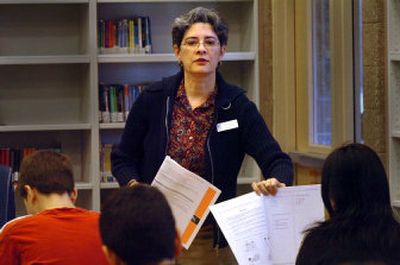

At the Woodland Middle School library Friday afternoon, a group of seven students sat for more than an hour with test papers in front of them.
Before the middle of next month, they’ll gather again to take two more parts of the test.
No, it’s not ISAT, the Idaho Standards Achievement Test.
These students are among the 35 Coeur d’Alene students who don’t speak fluent English. In accordance with the federal No Child Left Behind Act, Idaho this month began assessing the English language proficiency of non-native speakers.
Though district officials and teachers expressed a level of standardized test fatigue, they’re hopeful of what the new test might herald.
“If they’ll use it to help us, that’s what I want,” said Linda Powers, who oversees Limited English Proficiency, or LEP, programs for the district.
Powers said she hopes the test scores are used to garner more services and direct instruction – in short, “to support, not to punish or penalize.”
“The nation is recognizing our LEP population is our fastest growing subgroup,” she said. “It’s unfair not to provide services.”
Statewide, the number of students who fall into the limited English category has almost doubled in the past decade, from 11,267 in 1997 to 20,934 this year.
The new test, to be used by 11 Western states, has four parts: reading, writing, speaking and listening. The listening section must be done one-on-one with a test administrator. Together, all sections take about two hours to complete – almost three class periods.
The test is provided in five levels of proficiency, from beginner to advanced. Students are expected to bump up one level each year.
Districts’ progress will be measured by the number of students who advance, how much students improve on this test, and how many of them are proficient on the ISAT, the state test all students take.
Results of the Idaho English Language Assessment will be available in July.
Coeur d’Alene has for years tracked the progress of its non-native speaking students, who are mostly Hispanic.
The district immerses its LEP students in regular classes, pulling them out for special instruction as needed. For some students, that means three hours a day; for others, it takes 30 minutes a few times a week.
After the last students closed their booklets Friday, Ruth Hawley, an LEP teacher, said the general sentiment among test-takers was that the exam was long.
Still, Hawley reiterated the benefits of using a standardized test, including uniformity in the way districts track students’ progress.
She added: “It’s hard to strike a balance between having good information and not overdoing it.”