
Much better than a smew
Some birder friends of mine have longed to find a smew. They are the Warings, and they have talked about it a lot. Actually, I’d like to see one, too. The name alone is inviting, almost mythical sounding. And the name gives no hint as to what type of bird it might be. In fact, if I hadn’t already let you know that it’s a bird, you’d probably think it was a squished and smeared campfire treat.
One hint as to a smew’s identity would be its one-word name. Ducks are the birds that most often get away with that trick. It is, in fact, a beautiful little duck. At least the male is a beautiful little duck. The female looks an awful lot like a miniature female common merganser. Oh, there, I gave it away.
The smew is a Eurasian merganser, seldom seen in North America outside of Alaska. I know of only three or four sightings along the Pacific Coast. The male is mostly white, with a black mask, and its body separated into quadrants by fine black lines. It has a delicate, narrow black bill with merganser-type serrations around the edge. Yes, it’s a beauty.
But really, we don’t need a smew. This winter we have a celebrity bird staying here that is a close relative and is far more beautiful. It too is small for a merganser, and it too has a delicate, narrow black bill with merganser-type serrations around the edge. And the male has a bright yellow eye that looks more ornamental than optical.
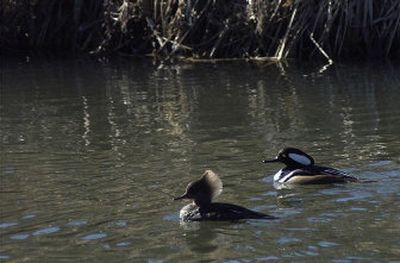
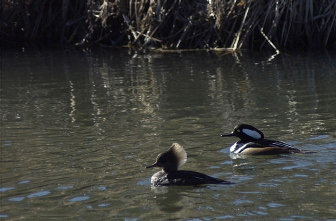
Our bird, that does not take second place, even to a smew, is the hooded merganser, and it’s the hooded merganser’s portrait that adorns the 2005-06 Migratory Bird Hunting and Conservation Stamp. Among wildlife artists, winning the commission to paint the stamp is a highly coveted prize.
Among ducks, it’s a singular honor to be so portrayed. All the duck hunters in the nation had carried the hooded merganser’s picture, if not the hooded merganser itself, in their pockets this past hunting season. By the way, if you don’t want to spend $15 for the stamp, you can buy a postcard of the stamp at the post office for considerably less. And the postcard is way bigger than the stamp.
So, we are honored this and every winter by the presence of the hooded merganser, the smallest merganser, and among the smallest of the group of ducks known as the sea ducks. It’s true that North Idaho doesn’t have a sea, but we still have lots of sea ducks every winter. That’s because we do have fish-bearing lakes that are large enough to not freeze over in the winter, and sea ducks eat fish.
The United States and Canada have 15 species of sea ducks that are native breeders. Three of these are mergansers: hooded, common and red-breasted. All three may be seen here in the winter, but the red-breasted is rare, and does not breed here.
The sea duck group also includes the eiders and scoters, the former are never seen here and the latter are rarely seen here in winter; the long-tailed duck, which is rarely seen here in winter; the harlequin duck, which breeds along North Idaho mountain streams, but is seldom seen in Kootenai County; the common and Barrow’s goldeneyes, the former which winters here in large numbers and the latter which winters here in smaller numbers; and the bufflehead, which like the hooded merganser, spends its whole year here.
Actually, though, the hooded merganser is a bit of an oddity here. It is primarily a bird of the East where it is known in swamp country by a number of nicknames you won’t hear around here: hairyhead, frog duck, tadpole duck. Frog comes from the sound of the male’s courting voice and tadpole refers to a component of the hooded’s summertime diet, but it is hairyhead that is the more interesting moniker.
As do all mergansers, hoodeds have a head crest that is quite showy in the male. As with all birds, however, it has nothing to do with hair. When at rest, both sexes may relax the crest, but when excited it stands up just as if it was made of the same bristles as those on an ancient Roman helmet. In the male, an elongated white facial stripe opens to a huge white flash of a fan-shaped crown.
The males are also quite distinctive in black, white, and cinnamon body markings, with that thin, tapering patent-leather-looking bill, and with that gold-piece-like eye. The goldeneyes have gold-colored eyes, obviously, but they having nothing on the male hooded merganser. He’s dressed for show and would fit in on any riverboat gambling trip of yesteryear.
Despite his beauty, all his gear is functional. The serrated bill is used to grasp wiggly fish. Being relatively small, hoodeds only get the smaller fish, but they also eat just about anything else that moves underwater and is the right size, including aquatic insects. They are great below-surface swimmers, using both feet and wings for propulsion.
That beautiful eye is also one (on each side) big bifocal. It serves its purpose in air, then the lens actually changes to adjust for the refractive differences of light underwater. Hoodeds see as well below the surface as they do above it.
And his showy clothes? They are strictly for the benefit of merganser lady-folk. Just as with the old professional gamblers as portrayed by Mel Gibson and James Garner, hooded mergansers are confirmed bachelors who use their fancy ways to win the hearts of many sweet young things.
Then, when breeding season is over, the males molt into a temporary set of clothes more drab than those of the female. They molt again in August and are rendered flightless for almost a month with the loss of all their flight feathers at once. They are probably too tired to fly anyway.
Female hoodeds, while not the glamorous types, are plenty unique themselves. They are among a small group of cavity nesting ducks that include the closely related buffleheads and goldeneyes, and the distantly related wood ducks. All these species depend upon natural tree cavities, abandoned woodpecker nests, or artificial nesting boxes to reproduce.
The hooded merganser, however, may not depend entirely upon its own nest to reproduce. As are a few other duck species such as the redhead and wood duck, female hooded mergansers commonly lay eggs in the nests of other birds. The host nest may be that of either another merganser or another cavity-nesting duck species.
Unlike the cowbird, however, which never tends a nest of its own, hoodeds do incubate eggs, though probably not all of which are their own. Just imagine if we could pick which children to send off for someone else to raise – I guess I had better not go there; I have two teens.
Hooded mergansers are also peculiar in the egg that they lay. It’s shaped more as a ping pong ball than an egg, with a shell about as thick as that of a golf ball. That’s got to be tough to get out of. But chicks of cavity nesting ducks have got to be tough. Within a day of hatching, they are excepted to jump headlong out of the cavity which may be 50 or more feet above the ground. I have seen video – they bounce just about like ping pong balls.
The female then tends the chicks, never actually feeding them, but protecting and teaching them, for 70 days before the young are ready to fly. It’s no wonder that hoodeds lay about a dozen eggs per clutch. Life is rough on pingpong balls and not that many survive the transition to flighted birdhood.
On the west side of the Cascades, hooded mergansers are already nesting. Here they will be soon. And that’s when they seem to disappear. Actually, there are probably more hooded mergansers here in the summer than in the winter, but sightings become difficult. Hoodeds are naturally secretive, and keep to small flocks even in winter.
This time of year, they are heading from the large lakes to small wooded ponds, sloughs, and streams. Since they tend to spend their summers where people do not, they are seldom seen. The few that migrated away late last fall are returning, and the ones that wintered here are preparing to breed. So now may be your best opportunity to get out and see a hooded merganser, in all it’s splendor.
It was another winter without a smew. Sorry, Warings. But who needs it? Our miniature merganser is even better. See one and you’ll appreciate why.