
SHOP TALK
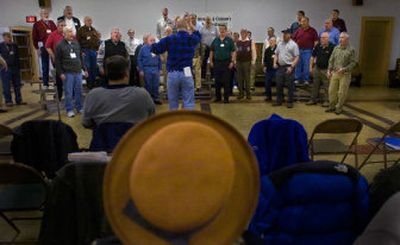

The director called a break halfway through Wednesday night’s practice, but some of the singers weren’t ready to take a breather.
They wanted to serenade the only lady in the room, strut their stuff and sing their favorite song: “Something” by the Beatles.
There was something a little different about it, though – these guys were a barbershop quartet.
“Barbershoppers never quit singing,” Chuck Lauerman said. “You can’t get them to shut up once they start.”
The retired grocer has been singing in Spokane’s Pages of Harmony barbershop chorus for 43 years.
The group, in its 55th year, performs its annual spring show, “King of the Road,” this afternoon and evening at Spokane Falls Community College. There are more than 50 members in the chorus, and many of them also sing in quartets.
Barbershop music consists of close, four-part harmonies sung a cappella, or without instrumental accompaniment. The tenor sings above the lead singer, the bass sings the lowest notes, and the baritone fills out the chords.
“Baritone is a challenge. It’s a little harder and more cerebral,” said Larz Hommel, who recently switched back to the more intuitive bass part.
“It’s fun being part of that big sound and letting it rumble through you,” he said.
When the four parts harmonize in just the right way, they create another sound that rings higher in the register – a phantom sound sometimes called the “fifth man.” That’s when the group knows it has hit gold.
Though the barbershop style is mainly associated with men, there are women’s groups, too – sometimes called “beautyshop choruses” – such as the Sweet Adelines.
Barbershop singing is a worldwide phenomenon, with groups in Australia, Uganda and everywhere in between. But barbershop is an American folk music, spawned from actual barbershops and other domestic settings in the early 20th century. It reached its peak of popularity during the vaudeville era of the 1940s.
Some chorus members may remember listening to the music in its heyday, when they were apple-cheeked young men a la Norman Rockwell. Today the Pages of Harmony has an aging population, slowly supplemented by a younger crowd.
That’s the beauty of it, they all say – barbershop knows no bounds. They are proud their group includes men from many walks of life, from repairmen and butchers to attorneys and dentists.
Bob Billings, a retired railroad engineer and 34-year barbershop veteran, said that after high school, there weren’t many opportunities to sing.
“It was either high society or church music,” he said. “This is kind of different. It’s fun.”
One barbershop antic is forming an impromptu quartet. Without ever having sung together before, members will perform their best rendition of a barbershop standard. It’s called a “polecat,” a sort of secret handshake among barbershoppers
Barbershop songs are divided into two categories: gut busters and tearjerkers. Gut busters have more pizzazz, and usually some arm-swinging choreography to keep the singers busy while they belt out the tunes.
But Mike Elliott, the Pages of Harmony director, is drawn to the sentimental, tearjerker ballads.
The rhythm of a song becomes less important than the lyrics in barbershop music, he said, because it is all-vocal. By changing the stress on certain words, you can interpret a song any way you want.
Lauerman, the retired grocer, also prefers ballads because of their emotional content.
“You should be singing thoughts, not notes,” he said. “I can express more through music than speaking.”
Barbershoppers don’t just use their voices to express themselves. Facial expressions, hand gestures and simple dance steps are requirements for a real barbershop show. There are even short skits to set the tone for each song.
“It’s not a lazy man’s sport,” said Elliott.
After a full day’s work Wednesday for many of the members, and two hours of harmonizing their hearts out at practice, the singers weren’t emoting up to the assistant director’s standards.
Jay Krumbholz wanted them to look like they meant it for one more run-through of “King of the Road.”
“I know you’re tired,” he said, “but some of you are just singing.”