
Fetching talent
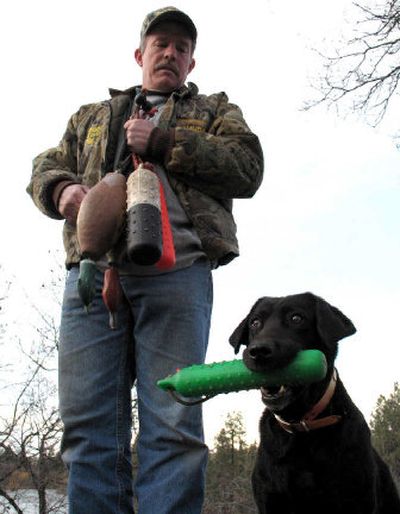
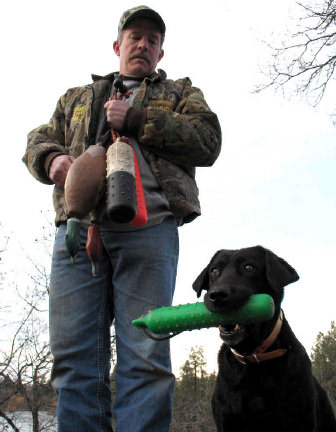
A local group of bird hunters is no different in the basic approach to their sports than hoopsters eyeing the NCAA tournament — your team is going to be a lot sharper and more successful if you don’t wait until the season opener to start practicing. The hunting seasons don’t start until September, but Spokane Bird Dog Association members launch a flurry of training and competitive activities with their canine partners starting in March.
“A lot of the things we do were started by hunters who couldn’t bear to see the hunting seasons end,” said John Gilbert, a Spokane fireman who teams with two Labrador retrievers for hunting activity or training virtually year-round. “But the bottom line is that it costs the same to feed a well-trained dog as it costs to feed a mutt. And a well-trained dog is a better family member. They’re a joy to be around.”
While some hunters might be intimidated by field trials dominated by professional trainers with dogs vying for championships, the local club features numerous activities for the average Joe.
“We fill a niche for somebody who simply wants to simulate the field hunting experience and improve his dog,” Gilbert said. “These dogs are happiest when they’re in the field, and so am I.”
The club has contingents for flushing and retrieving breeds as well as pointing breeds. Normally these two groups hold their activities separately, but on April 22 the club has scheduled its fourth annual “Fun Hunt” in which pointers and flushers compete against each other in 15-minute braces to see who can bag the most pen-raised chukars.
The retriever group is the most active this spring and a March 25 “picnic test” at the club’s Espanola training grounds near Medical Lake is a good opportunity to either watch or participate.
The picnic tests are the ground floor for retrievers working their way up the ladder of talents, from single retrieves to multiple marked retrieves and eventually to blind retrieves in which the handlers use hand signals to direct the dogs to a previously unseen dummy or bird.
“Labs tend to dominate some of these retrieving games, but any breed could compete,” Gilbert said, noting top performances by springer spaniels, golden retrievers and others.
Picnic tests are low-cost events that put hunters and their dogs out in a competitive setting, except that the handler is allowed to use an electronic collar and indulge in training as needed. More serious hunters may progress to “licensed hunt” competitions, which may cost $35-$60 for birds and judging. No training aids are allowed in these more competitive events.
“Dogs love the excitement of the people and the birds in any of these events,” Gilbert said. “When they jump out of the truck, it’s just like a day of hunting for them. They get pretty pumped.”
Some hunters go beyond the loosely competitive “fun” events and take their dogs to higher levels in North American Hunting Retriever Association activities.
“Still it comes down to NAHRA’s basic philosophy that a trained retriever is a conservation tool,” Gilbert said. “A hunter with a good retrieving dog rarely loses a crippled bird.”
No one should worry about being embarrassed at the way his dog performs at one of these events, Gilbert said. “It happens to everybody, even the pros,” he said. “We all know that dogs sometimes do unusual things when they have an audience.”
Gilbert has run Labs for 17 years, and he say’s he’s still learning.
“The average hunter who just hunts doesn’t have a perspective of what his dog is capable of,” he said. “Most hunting dogs perform far short of their potential.
“The picnic test is a way of measuring your dog’s progress, but mostly it’s a place to network with other hunters and trainers. Some people form training groups with people they meet at these events.”
Dog training is open to innovation, but mixing with experienced trainers helps hunters learn the proven steps in advancing a dog, he said.
“Your dogs are always learning from you, and sometimes they’re learning the wrong thing without you knowing it,” he said. “For example, if you throw a training dummy the same way and distance every time, pretty soon the dog will look to retrieve only as far as you can throw.”
Having bird dogs that follow hand signals and stop and sit on command has opened opportunities for Gilbert, such as an autumn invitation to handle his Labs for guided pheasant hunts in South Dakota.
“Well-trained dogs are worth gold in those situations where you’re assigned to hunt certain fields,” he said. “People who pay to hunt don’t want to see a dog running wild and flushing their birds into somebody else’s field.”
But mostly, Gilbert trains dogs nearly year-round for his own enjoyment.
“It takes more money to drive a fancier rig or to shoot an Italian shotgun, but we only have to invest a little more time and effort for the pleasure of running a better dog,” he said.