
Religious lightning rod
BOSTON – The groundbreaking for a towering new mosque in this city’s Roxbury neighborhood was like a sigh of relief for local Muslims.
After a decade of delays, Muslims who had worshipped in mosques so cramped some were forced to pray in parking lots looked forward to sharing the massive building. They also welcomed the community’s pledges of unity – barely a year after the Sept. 11 terror attacks.
“This center will defy the stereotype that ‘Muslims don’t build things; they just tear down things,’ ” says Zakiyah Bilal, a local Muslim who attended the November 2002 ceremony.
Now, more than three years later, the Mosque and Cultural Center is unfinished, and funding has dried up. Media reports linking the mosque’s builder, the Islamic Society of Boston, to Muslim extremists have led to defamation suits.
A project that was supposed to signal openness has become a symbol of chronic mistrust.
“What has happened … has been very public and very damaging,” says Salma Kazmi, assistant director of the Islamic society.
Planning for the $24 million mosque began in the early 1990s. It took a major step ahead in 2000 with a deal in which the Islamic Society, or ISB, acquired its project site from the city for $175,000 and in-kind contributions.
(Yet another lawsuit stemming from the project charges the price was so far below market value it amounts to an illegal government endorsement of a religion.)
About a year after the groundbreaking, the Boston Herald wrote the first reports connecting the Islamic society to extremists, including Abdurahman Alamoudi, one of the society’s founders.
Alamoudi is serving 23 years in prison after a 2004 conviction for illegal financial dealings with Libya. After his guilty plea, the Department of Justice called Alamoudi “a major player in the financial support of terrorism.”
The writings of a society board member, Walid Ahmad Fitaihi, also came under scrutiny, including articles in which Fitaihi called the Jews “murderers of the prophets” and said they will be “scourged” because of their “oppression, murder, and rape of the worshippers of Allah.”
The reports also explored a link to Sheikh Youssef al-Qaradawi, a Sunni cleric who was offered a position on the society board in 1993 and promoted the mosque in a 2002 fund-raising video.
Al-Qaradawi has since issued a religious fatwa that unborn Jews should be killed because they’ll grow up to join the Israeli army. He also supports suicide bombings in the Israeli-Palestinian conflict and in Iraq.
Critics say the Islamic society never explained such ties or distanced itself from hateful rhetoric. Then, they allege, it punished private citizens who were asking legitimate questions about the ISB and the new mosque by including them in a defamation suit filed last year against media outlets.
“This is really an attempt, and not an unsuccessful attempt, to terrify people,” says Jeffrey Robbins, an attorney for several defendants.
The ISB’s attorney, Howard Cooper, says the society is acting in self-defense after a smear campaign designed to undermine the mosque project. Cooper says the society has repeatedly condemned anti-Semitism and that its alleged connections to extremists don’t exist.
“My clients are victims of overaggressive, intimidating intolerance, nothing less than that,” he says.
According to the ISB’s court filings, Alamoudi hasn’t been associated with it for years. The Islamic society says it had nothing to do with Fitaihi’s statements, and Kazmi says they led the ISB to adopt a values statement clearly condemning anti-Semitism.
The ISB also says it no longer has a connection to al-Qaradawi, who was offered a place on the board before he became controversial. Asked why they later enlisted al-Qaradawi to promote the project, Kazmi says that, in the Middle East, he is widely considered a moderate with appeal to those the ISB hoped would support the mosque.
But the fact the ISB would willingly associate with al-Qaradawi shows there’s a problem, says terrorism expert Steve Emerson, who was a source for the media stories and is named in the suit.
“If I had somebody on my board saying all blacks should be lynched, I don’t think I’d say, ‘Well, I like his point on remedial reading,’ ” Emerson says.
An offer by the Islamic society early this month to resolve the defamation lawsuits through mediation hasn’t been acted on. And interfaith talks between the ISB and local Jewish groups have ended.
Kazmi says donors are scared to be linked to the mosque because of the controversy.
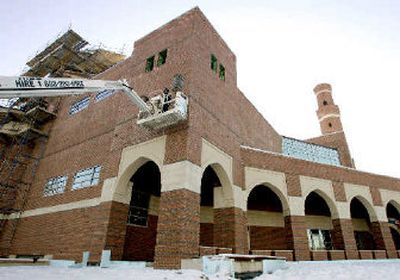
More than a year after the mosque was supposed to be completed, the red brick building is a shell, with construction frozen about $4 million short in the $14-million first phase.
Next to it, the final piece of a 125-foot minaret sits on the ground.