
Gardner’s campaign
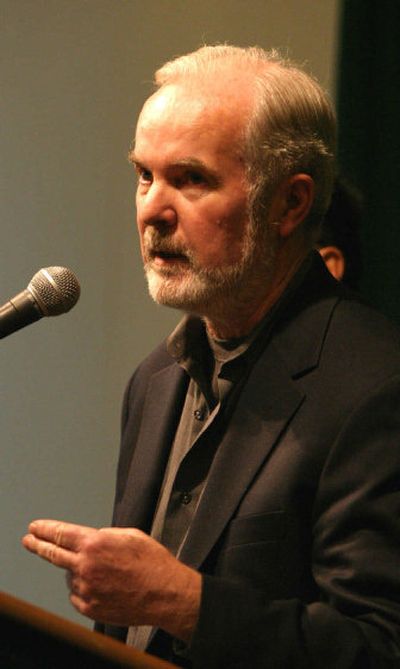

SEATTLE – “What do you do for exercise?” asks Booth Gardner, and it’s not long before the 69-year-old former two-term governor of Washington state is sharing tales of marathons run and mountains climbed.
But soon this lanky, bearded man with a trademark gruff style turns to his latest and perhaps last campaign, one that has abruptly put him back in the public eye and to which he brings a perspective full of both psychic and physical pain.
Gardner is campaigning for the right to die.
It’s not quite that simple, of course. Anyone can die – “I could go out in the garage and blow my brains out, but that’s not what I’m talking about,” says Gardner, who describes his body and spirit as progressively weakened by Parkinson’s disease, with which he was diagnosed 13 years ago. “That’s not dignity.”
In light of the recent U.S. Supreme Court decision that upheld Oregon’s assisted-suicide law, neighboring Washington is one of many states where lawmakers or voters will consider the complex issue.
Oregon, the first and still the only state with such a program, allows terminally ill patients to receive a lethal prescription of drugs that can enable them to hasten death.
Governor from 1985 to 1993, Gardner, a Democrat, who was diagnosed shortly after he left office, lends some high-profile and personal support to the drive for right-to-die legislation.
Advocates say they hope to bring the issue before voters with an initiative in 2007 or 2008; opponents vow a vigorous campaign against it.
But contentious as the issue is, Gardner’s circumstances may add even more fuel to the debate.
For one thing, as he explains in an interview, he said the Oregon law doesn’t go far enough.
Oregon’s requirement – that a person must receive a medical prognosis from two doctors that he or she has six months or less left to live – might never apply to a person in his condition. Parkinson’s, while it can be progressively debilitating, is generally not fatal.
“I have this little game I’m playing: Do I die of Parkinson’s or old age?” Gardner says at the 6th Avenue Bar & Grill, a downtown hangout that is his spot of choice for an interview.
“I’m old age. Parkinson’s is Parkinson’s,” he says. “I want to win.
“But still I can see, foreseeably, that Parkinson’s can take me down to the point where I can’t be functional anymore,” he continues. “And I’ve had a great life. … So when I can no longer enjoy that life and I don’t see how I can contribute, and I’m a worry to my kids and wife, then I want to go.”
Parkinson’s, Gardner says, “ravages your soul” as it slowly erodes one’s ability to walk, or even to move the muscles needed to talk. And his life is a mix of bad (“off”) and good (“on”) periods.
“Being ‘off’ is the worst thing I’ve ever been through. I can’t talk. I shuffle, or I can’t stand up at all. I’m ‘on’ now, so I have no trouble talking to you. But if my downtime increases and my ‘on’ time decreases, I’ll reach a point where the quality of life isn’t worth it.
“I’ve made all the tough decisions in my life,” he says, including school, politics, marriage and divorce. “I have the right to make the last decision.”
But even advocates of medically assisted suicide say they would not back a law more open-ended than Oregon’s.
“I don’t think we would ever support anything that extended to people who were not terminally medically ill,” says Barbara Coombs Lee, president of Compassion & Choices, a nonprofit group with offices in Portland and Denver. “It’s too ambiguous to enforce.”
In yet another way, Gardner concedes, his own case underlines the moral complexities of his right-to-die advocacy: Even those closest to him are deeply split.
As the former governor bluntly puts it: “My wife is supportive, my daughter is supportive. My son is a Christian, a born-again Christian.”
Gardner offers a half-laugh at how that comes out. Not a churchgoer himself, he says he deeply respects his son Doug’s religious perspective.
Doug, a delegate to the 2004 Republican convention, says he opposes legally sanctioned suicide because society should “err on the side of life.” As to whether he would be in the room if his father chose to take his life, he said that was “a private family matter” that he would prefer not to discuss.
And, of course, it may well never come to that. In Oregon, though lethal drugs are widely discussed and legally available, an average of about 30 people a year have taken their lives using them in the eight years since the law took effect.
Like a lot of people who are healthy, Gardner says he never gave a lot of thought to his own death in the years when he was a rising star in politics.
In 1991, there was an initiative on the state ballot legalizing assisted suicide. But not only did he not take a public position on it, Gardner says, he can’t even recall how he voted on it. (The measure was defeated.)
“I haven’t the slightest idea. I was thinking about life, not death.”
Looking back, he says, the change may have begun in his last year as governor. He was “depressed beyond belief” in that time, he says.
“I like conflict; it spices up my life. And I like making decisions. … I didn’t make a decision my last year as governor. I avoided decisions. I avoided conflicts.”
Divorced from his wife of 35 years, Gardner took an ambassadorial position in Geneva from President Clinton, as U.S. delegate to GATT, the General Agreement on Tariffs and Trade. Gardner calls the organization “the General Agreement to Talk and Talk,” and says he was unhappy in the diplomatic life.
He also knew something was physically wrong. He felt incredibly stiff. “I was like the Tin Man walking,” he recalls. He went to a doctor in Geneva.
“He asked me to walk up and down the hallway,” says Gardner. “Then he tells me, ‘We’ve been together 10, 15 minutes, and you’ve neither blinked nor changed facial expression.’ “
“So?” Gardner told the doctor.
“That means you have Parkinson’s,” the doctor offered bluntly.
Gardner returned to Seattle and found that quick diagnosis confirmed. Medication for Parkinson’s helped alleviate the symptoms, and antidepressants helped lift his mood.
He married again, to a Texas native he met in Geneva. In time, he went public and helped raise funds to defeat the disease; he helped establish the Booth Gardner Parkinson’s Care Center at Evergreen Hospital Medical Center in Kirkland, across Lake Washington from Seattle.
Gardner says depression is a periodic demon in his life, but he insists that it is not playing a role in his new campaign.
“I’m not trying to open the door for people that are 60 years old and depressed because their wife left them after 35 years or something,” he says. “Not at all.”
Gardner says he wants “to be in the position where – on a Sunday afternoon, in the summertime, this is the ideal – I’m with my kids and grandkids and I say to them, ‘Come here, I’ve got to talk to you.’ “
“And they come and I say, ‘Friday’s my day. That’s when I want to leave. Let’s spend the rest of the week hanging by each other.’ That’s dignity.”