
Weighty issues

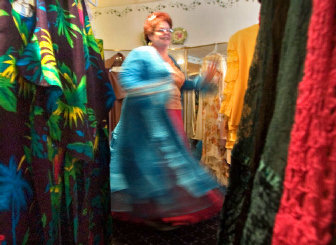
Nanette Gallas sits down, pushes out a deep breath and declares her fatigue.
She’s had a long weekend, but hopes her hard work may have drummed up sales for her Dress Me Beautiful boutique in the Garland business district.
Now into her 15th month running a small business, Gallas has found success by specializing in dresses that won’t be found in most shops, and most importantly, in an array of plus sizes.
It’s an understanding of her customers.
Consider this: About 127 million American adults are overweight, another 60 million are considered obese and 9 million more are severely obese.
“Women of all sizes want style, fashion and beauty just like anyone else,” she said, adding with a grin: “Gee, who would’ve thought that women like to buy beautiful clothes?”
Across Spokane, businesses are accommodating heavier people. They recognize the business opportunity of selling goods and services to people considered overweight or obese.
“It’s about time,” said P.J. Trzeciak, who owns the PJ & Co. modeling agency in Spokane that includes several plus-size models.
“I tell you what,” she said, “if I were young and starting in business, that’s something I would consider.”
There’s no question that battling weight is big business in America. Yet two-thirds of Americans are overweight, and the trend keeps climbing, representing a market that’s being targeted by retailers and service providers nationwide.
Here are a few examples from the Center for Science in the Public Interest:
• Newer seats in Fenway Park, home of the Boston Red Sox, are four inches wider.
• More benches and bigger seats were added to Seattle’s ferry fleet.
• Plus-size boutique Lane Bryant is opening hundreds of new stores.
• Nike changed its sizes for women’s fitness apparel.
• The Federal Aviation Administration required airlines to add ten pounds to average passenger weights.
• Doctors and lab workers are using longer needles to pierce thicker fat layers when drawing blood or administering vaccines.
Even Ford Motor Co. is designing what it calls a “Smart Seat” that would swivel outward for easy entry. The company is also designing an “EZ Portal” that combines sliding front and rear doors to go along with new seats, which could help overweight and obese people get into and out of cars and trucks.
Those national trends have forced changes at Sacred Heart hospital.
Sacred Heart surgeons performed 150 gastric bypass operations last year, said Sena Blickenstaff, director of the hospital’s bariatric, orthopedic and neuroscience units.
The hospital has spent hundreds of thousands of dollars on new equipment and training, from larger wheelchairs, hospital beds, toilets, patient lifts, stretchers – even bigger chairs for family members who wish to sit by a loved one’s bedside. Staff has undergone sensitivity training to better serve the growing number of obese patients who require medical treatment.
“We’ve had to make adjustments and continue to do so,” Blickenstaff said. “It’s been very, very expensive. And we’ve had to change some of our lift policies to protect our staff, too.”
Sensitivity is an important part of targeting larger Americans, businesses say. Fat jokes may have been hurtful in the school yard, but in the business world, such attitudes signal ignorance that can cost sales.
“People want to live the best lives they can and businesses should be there,” said Ivan Tuttle, vice president of sales for Scooters America, a major seller of motorized scooters and wheelchairs headquartered in Post Falls.
Tuttle said sales due to obesity are now about 8 percent of the company’s business.
“We haven’t necessarily catered to that,” he said.
Most scooters are purchased with private insurance dollars or financed by Medicare or Medicaid. Scooters built for obese customers can cost between $10,000 and $12,000 — half what they cost years ago.
While using scooters can seem like a crutch, or even worse, an enabler, for obese people, Tuttle sees it differently.
He tells of a man who weighed 975 pounds because of an unusual medical condition.
“This man couldn’t even leave the house to watch his kids play baseball,” Tuttle said. “It just breaks your heart.”
Outfitting him with a custom-built scooter changed his life, Tuttle said.
In many cases, obese people are saddled with such low self esteem that they become shut-ins.
The cycle of overeating with no physical activity and no outside contact exacerbates the problem, Tuttle said.
He said something as simple as a scooter to can help some people change habits – help them live better emotionally and physically.
“Once people become active again – get out and start doing things again – they can begin losing weight,” he said.
Paul Paradiso, retail manager for Northwest Bedding of Spokane, said he wasn’t sure how many mattresses are sold each year to overweight or obese people.
Why? “Fortunately, maybe by luck, technology and better designs have made mattresses stronger and more comfortable anyway,” he said.
Because people want beds to last, Northwest Bedding’s sales force gently steer people toward an appropriate mattress, Paradiso said.
“Of course everybody wants a luxurious soft mattress,” he said, “but the more weight, the more wear.”
Northwest Women Magazine recently published a fashion spread that featured several plus-size women. The response was immediate and powerfully positive, said Charity Doyl, editor of the Spokane-based publication.
“Why not show real women? This is who we are,” she said.
It was inspired by Dove soap ads.
“I think our fashion pages were so popular because these women — all locals by the way — were celebrating who we are,” Doyl said. “Let’s face it, most of us aren’t 5 feet 8 inches, 120 pounds and under 20.”
Doyl knows her readership, and she knows they don’t mind “seeing curves, gray hair, wrinkles and all.”
Gallas had that figured out 25 years ago when she was a young woman finding it difficult to find attractive clothes.
“It was then that I dreamed of opening my own dress shop for the bigger woman,” she said.
Instead she pursued college degrees and began earning paychecks as a social worker. She filed away the idea of opening a dress shop until taking a risk in late 2004.
“I finally did it,” she said while rearranging dresses in the crowded boutique.
“I had one guy, a wholesaler who shall remain unnamed, tell me that I had to pick between being a dress shop for small women or plus-size women.
“That’s when the rebellious side of me said ‘Oh Yeah?’ I don’t think it matters. Why should it?”