
On the fence
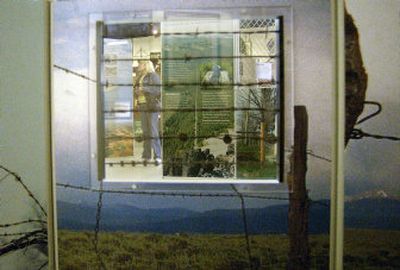

Visitors to the Spokane Valley Heritage Museum are in for a treat: A traveling exhibit from the Smithsonian Institution is in town. It’s the first exhibit of its kind to come to the Valley.
“Between Fences” chronicles America’s development – using fences as springboards for the story.
The tale begins with Native Americans, who eschewed fences and did not believe in owning land, and continues up through today’s U.S. border clashes.
Photos, postcards, drawings, advertisements, a diorama, tools and compelling quotes converge as colorful details from yesterday and today.
Fencing materials, like pickets, stones and barbed wire, also are woven throughout the display.
Viewers are encouraged to contemplate fences’ roles in advancing ownership, controls, aesthetics and exclusivity.
All the themes are central to the Valley, said Museum Director Jayne Singleton.
Consider the progression of Native Americans, pioneers, farmers, developers, land speculators and subdivision dwellers who have variously called the Valley home.
Many have used fences to secure their dreams.
“There are so many points of contact and reasons why the exhibit is a good fit for our community,” said Singleton, who wrote a grant that convinced Washington, D.C., officials the Valley should be among the six sites in the state to host the display.
Kids will enjoy it, too, she said. They’re charmed by kid-specific moving parts, tiny windows and graphics.
Why use fences as the central theme?
Perhaps the exhibition quote from Jean Jacques Rousseau says it best: “The first man who, having fenced in a piece of land, said ‘this is mine’ and found people naïve enough to believe him; that man was the founder of civilized society.” His words are taken from his 1754 work “A Discourse on the Origin of Inequality.”
An authentic fragment of Valley history helps bring the story full circle.
A 3-foot stretch of stone wall from an old area apple orchard has been reassembled within the exhibit. It seems to glide into a sweeping Otis Orchard farmscape.
Resident Chuck King discovered the remnant wall, dismantled it and rebuilt it in front of a custom mural by Al Shrock. Both are museum volunteers.
Their work creates a “peaceful, tranquil and evocative scene that captures the Valley of the past,” said Singleton.
In addition, succinct lessons are offered on such topics as deforestation, a result of settlers’ appetites for 6-foot-tall palisades and later split rail or worm fences and America’s Homestead Act, which conveyed a quarter-section, or 160 acres, of untamed land to settlers starting in 1862.
Visitors also can see brief accounts of the four fence wars that divided our nation between 1870 and 1920, and snicker at “grudge fence” in a turn-of-the-century photo.
“This show gets you thinking about your own life, your country, your community. It touches all those areas of our existence,” said Singleton.
Take contemporary times, for example: In most places, land sells at higher prices than ever before. Those flush enough to snap it up can purchase a coveted condition – privacy.
That privacy is often protected behind fences and gated communities.
“Privacy is becoming the new status symbol in a society that is increasingly crowded,” notes an exhibition passage from Virginia Scott Jenkins’ 1994 treatise “The Lawn.”
These and other fencing questions “continue to structure American life at the beginning of the 21st century. The answers will shape the environment, the economy and lifestyles,” according to one of the show’s concluding quotes.
The Smithsonian Institute’s Traveling Exhibition Service created “Between Fences” for its Museum on Main Street initiative, which sends quality works to smaller towns. Additional support for the show came from Humanities Washington.
“It’s not everyday you get to see an exhibit from our nation’s premier museum,” Singleton said.