
‘Day Without Gringos’ in Mexico
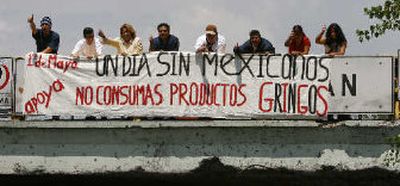
MEXICO CITY – A daylong protest dubbed “A Day Without Gringos” drew thousands of Mexicans into the streets Monday and kept many away from U.S.-owned supermarkets and fast-food restaurants to support rallies in the United States demanding immigration reform.
Some Mexicans said staying away from U.S. businesses was tough, and customers streamed into some branches of Wal-Mart, McDonald’s and Burger King in Mexico City.
Wal-Mart shopper Juan Ortiz, a 28-year-old salesman, said he supported legalizing migrants, but didn’t think it was practical to boycott U.S. goods. “You have to buy what is least expensive here, and I have to buy things for my family,” he said.
In the border city of Tijuana, across from San Diego, about 400 boycott supporters blocked half the access lanes to an international bridge to discourage Mexicans from crossing into the United States to shop.
However, it was hard to measure the boycott’s impact because business is usually reduced to a fraction of normal volume on Mexico’s May Day holiday.
Thousands of unionized workers – who traditionally hold labor rallies on May 1 – dedicated Monday’s marches to the cause, carrying banners that read “Total Support for Migrants.”
“The protests coincided with a nationwide “Day Without Immigrants” in the United States, where hundreds of thousands of mostly Hispanic immigrants skipped work and took to the streets. Some in Mexico saw the marches as the beginning of a new, cross-border Latino movement.
“This is a great revolution of the bronze race, the brown race,” Marti Batres, Mexico City leader of the leftist Democratic Revolution Party, told a rally. “Our nation goes beyond the Rio Bravo (Rio Grande),” he said, noting that half of Mexico’s territory became the western United States.
In Mexico, federal officials tried to distance themselves from the events. But at least a half-dozen state governors endorsed the boycott of U.S. companies.
Masked Zapatista rebel leader Subcomandante Marcos told a rally of about 2,000 supporters outside the U.S. Embassy that immigrants in the United States are “fighting in the belly of the beast.”
“As Zapatistas, we support the boycott of all the U.S. products that have proliferated in Mexico,” he said, vowing to “expel from our land all the rich and powerful … including, of course, U.S. capitalists.”
The Zapatistas led a brief armed uprising in 1994 in the southern state of Chiapas to demand greater Indian rights, and have since been locked in an uneasy truce with the government.
Celestino Garcia, a 32-year-old sandwich seller outside the Wal-Mart, said the number of shoppers was the same as on any other day. It also appeared to be business as usual at a McDonald’s in a working-class neighborhood near the airport.
But the boycott appeared to be taking its toll on some businesses. Marina Serna, deputy manager for a downtown Burger King, saw only one customer in the first 90 minutes of operation. She called the boycott misguided, saying her restaurant was owned by Mexican franchise holders.
“Even if we work in a company with an international brand, the owners are not from the United States,” she said.
Shawna Kelly, visiting Mexico City on business from San Diego, said the boycott could backfire.
“They shouldn’t boycott businesses like McDonald’s, because they’re employing Mexican people in the U.S.,” she said. “The more you do this, the more you make Americans angry.”