
78 Montanans pardoned for World War I sedition
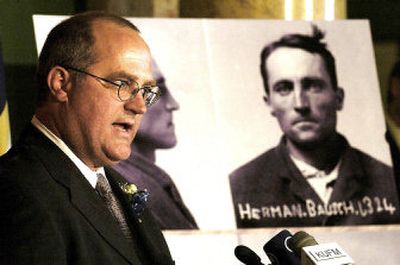
HELENA – Farida Briner remembers her mother talking about the day a committee of fellow Montanans confronted her German-born father on the family farm near Billings. “We should hang him from his own apple tree!” she said one of them yelled.
Herman Bausch’s crime? He spoke his opposition to the war being fought in Europe in 1918, and the Liberty bonds and stamp drives that supported it.
Briner’s mother, 19 and with a newborn in arms, went and stood defiantly in front of the tree.
On Wednesday, Briner, 75, stood in the rotunda of the Montana state Capitol and watched Gov. Brian Schweitzer sign a pardon of Bausch and 77 other Montanans convicted and jailed for sedition during World War I.
The pardons were the result of research by a University of Montana professor that inspired a group of law and journalism students to help clear the names of men and women who spoke out against the government in another time of war.
Montana’s sedition laws served as a model for the federal sedition laws also passed in 1918. Other states had such laws, but none was more vigorous in pressing them than Montana.
Remarks that were labeled seditious – in one case, observing “This is a rich man’s war” in a saloon – carried fines approaching $20,000 and sentences of up to 20 years in jail.
Martin Wehinger told a group of teamsters “We had no business sticking our nose in there, and we should get licked for doing so.” He served 18 months in the Deer Lodge State Penitentiary.
In 1918-19, 150 people were charged under the sedition laws. Forty men and one woman served time in state prison. One man had his sentence overturned in the 1920s on appeal, when it was discovered that witnesses had lied at his trial.
For Schweitzer, the descendant of ethnic Germans who emigrated from Russia, the issue had both personal and patriotic resonance.
“I want to send a message,” said Schweitzer. “Neighbor informing on neighbor, this isn’t the American way, it isn’t the Montana way, it isn’t the cowboy way. We weren’t the only state to have this kind of hysteria, but we will be the first state to say, ‘We had it wrong.’ “
Clemens P. Work, a University of Montana journalism professor and author of a book about the sedition cases, “Darkest before Dawn,” had researched the subject for more than four years.
Work directs the Montana Sedition Project, a group of law and journalism students from the University of Montana who petitioned the governor for the pardons on behalf of the families of those convicted. Jeff Renz, of the university’s law school, also worked with the group.
Peter Lachy, a third-year law student at the University of Montana from Dubois, Pa., said the students “did a lot of legal research, to determine if the governor could grant the pardons, and if we had the standing to ask for the pardons.”
The Sedition Project sent a letter to the governor at the end of March, asking that he consider granting these petitions. It was signed by 39 lawyers and historians, including First Amendment attorney Robert Corn-Revere.
Corn-Revere, who worked on Lenny Bruce’s 2003 posthumous pardon for a 1964 violation of New York state’s obscenity act, said he feels that the importance of the Montana pardons is more than just correcting history.
“It is of particular importance right now,” said Corn-Revere, “as we are constantly bartering our rights away in return for more security. It is the same deal with the devil that we made in 1918.”