
First lady is Republicans’ first choice in fundraising
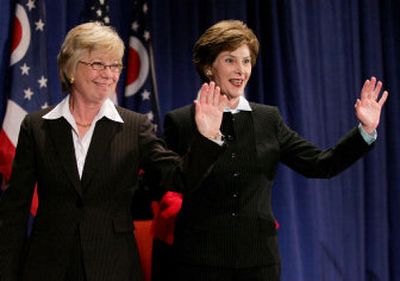
COLUMBUS, Ohio – In a crowded hotel ballroom in this battleground state earlier this week, Republican campaign donors munched on chicken satay and sipped tomato basil soup shooters as Laura Bush pulled off a feat her husband would have had a hard time accomplishing. She stayed above the fray.
“She’s unruffled by the atmosphere in Washington that the rest of us all live in daily – she just floats above it,” Rep. Deborah Pryce told the well-heeled crowd that had gathered at the Hyatt Regency on Tuesday and plunked down $250,000 toward Pryce’s re-election bid to be in the same room with the first lady.
Bush, Pryce said, is “a class act in a city that really needs one.”
In these days of tanking approval ratings for President Bush and re-election jitters for lawmakers, Laura Bush, perhaps more than any other figure in her husband’s orbit, is the ultimate campaign trail asset. With a blend of star power, fundraising muscle and popularity that Republican candidates covet, Laura Bush brings none of the messy partisan blemishes of her husband or the party’s other big money magnet, Vice President Dick Cheney.
That makes the first lady an attractive draw for moderate Republicans and conservative candidates in swing districts, many of whom are loath to cozy up to Bush lest they be linked with his unpopular policies, especially the war in Iraq. Still, they are eager for the publicity and campaign cash a presidential visit can bring.
“I don’t think there’s anybody who has a beef with Laura,” said Don Freels, the head of the state Realtors association, as he polished off some pastries awaiting the first lady’s appearance. “On the other hand, if George W. came in here, there would be demonstrations outside and all sorts of distractions.”
Laura Bush and her party are increasingly taking advantage of her status, stepping up her campaign schedule during the six-month sprint to Election Day. As she tours the country talking about her interests – including literacy, rehabilitating Gulf Coast schools and an anti-gang initiative – the first lady is quietly filling the coffers of Republican candidates. She made three fundraising stops last month, drawing $700,000 for Republican candidates, and plans to increase her campaign-trail exposure in the coming months.
A January Gallup/USA Today poll put the first lady’s approval rating at 82 percent, nearly 50 points better than the 34 percent approval rating for her husband, released by Gallup Tuesday.
“She’s immensely popular, and much more so than the president,” and she has an “appeal beyond the Republican base,” said John C. Green, a University of Akron political scientist. “A lot of candidates right at this moment would rather have Laura” than the president in their districts, he added.
Pryce is a case in point. A seven-term conservative and the No. 4 member of her party’s leadership team, Pryce must maintain the support of her constituents in this mostly suburban district in central Ohio, including a sizable contingent of moderate women, to retain her seat.
It could be a tougher-than-usual contest for Pryce, who faces a strong Democratic challenger in Mary Jo Kilroy, the Franklin County commissioner.
The first lady was on hand to vouch for Pryce on Tuesday. Pryce is “a role model in what women can do in public service,” the first lady said.
Republican officials say they see Laura Bush as one of only a few Republicans who can go into such pivotal, hotly contested areas and appeal to centrists and to the president’s conservative base.
“Her appeal transcends partisanship,” said Aaron McLear, a Republican party spokesman. The initiatives she promotes are “issues that everyone, Republican or Democrat, can rally behind. That’s why she can go into areas that may be more Democrat than Republican.”