
Senior papers
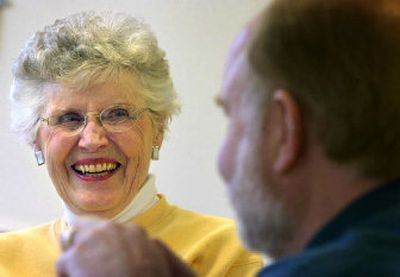
They are students.
They do their homework, and once a week they go to class with notebooks, pens and pencils. When it’s time for them to read aloud, they blush, and swallow and stammer a little.
They’re students, but they’re not kids.
Some of them have white hair. Many have faces that show lines etched by years – by a lifetime of experiences, memories and impressions.
But they all have one thing in common: They want to write.
The Senior Program offered by the Community Colleges of Spokane offers classes for people who are 55 years old or older. One of the most popular classes is Virginia White’s writing workshops.
White worked as a freelance writer for years and penned a column for a local women’s magazine. She spent time on the faculty at Eastern Washington University and authored a book about the history of needlework. She still writes for pleasure.
For the last 17 years White, who is 67, has worked with people who want to learn to be better writers. She works in classrooms across the city. Currently she meets with each class once a week at three locations across the area.
After assigning a topic, or writing exercise, White’s class participants write on their own time and bring their work back the following week.
The stories they bring back, written in longhand on ruled paper, or typed on typewriters or computers, are rich.
Some are personal stories: tales of childhood or military adventures. Other students bring short stories or chapters of the novel they are working on.
A number of White’s students are published poets and authors or have secret ambitions to achieve that status. All harbor a strong desire to put their words on paper.
Virginia Meyer, 81, is one of the students with the longest history in the class. She likes the long-term benefits of the exercises White assigns.
“It keeps me sharp,” she says. “Writing helps keep me interested and alert.”
Another is Charlotte Wilkerson. Wilkerson is tiny with a no-nonsense air.
A former teacher, she likes to write in colorful cowboy doggerel. In response to White’s assignment, “Go Out and Play,” Wilkerson’s essay tells the story of a childhood spent outdoors, under the sun.
White is a gentle teacher. She coaxes stories out of the minds of participants who insist they’ve led quiet, uninteresting lives.
She leads the discussion after someone reads aloud and finds ways to encourage while offering advice.
Occasionally she reads items clipped from the newspaper or from a magazine aloud to her classes as an example.
The class members are gentle with one another. There aren’t any harsh words after a reader finishes – only encouragement.
“Within a few days of joining the class, we turn into a family,” a woman with snow-white hair, a fiction writer, says. “You feel safe.”
Women outnumber the men in the classes, but there are a few males.
One has a history with the military, one writes detective stories, and another is still active in the business world. He uses poetry in his work as a business consultant.
Their pasts are varied, but they share a common drive
“The thing you see with people old enough to be in these classes is a sense that they have something to say,” White says. “They have a story they want to tell, a story their families want them to tell.”