
Release of records questioned
WASHINGTON – While Capitol Hill debated the issue Friday, many lawyers voiced surprise that three major phone companies had agreed to make available to the NSA the phone records of tens of millions of Americans.
That’s because Congress made it illegal 20 years ago for telephone companies and computer service providers to turn over to the government records showing who their customers had dialed or e-mailed.
“I would not want to be the general counsel of one of these phone companies,” said Orin S. Kerr, a law professor at George Washington University and a former Justice Department lawyer who has worked on electronic surveillance.
Kerr was referring to the disclosure Thursday that the Bush administration has been secretly collecting the domestic phone call records of millions of Americans. The government reportedly obtained the records from AT&T, Verizon and BellSouth but was turned down by Qwest Communications.
The law doesn’t make it illegal for the government to ask for such records. Rather, it makes it illegal for phone companies to divulge them.
The Electronic Communications Privacy Act of 1986 was passed when cell phones and the Internet were emerging as new forms of communication. Section 2702 of the law says these providers of “electronic communications … shall not knowingly divulge a record or other information pertaining to a subscriber or customer … to any government entity.”
Companies that violate the law are subject to being sued and paying damages of at least $1,000 per violation per customer.
“It is simply illegal for a telephone company to turn over caller records without some form of legal process, such as a court order or a subpoena,” said James X. Dempsey, a lawyer for the Center for Democracy and Technology in San Francisco.
USA Today, which disclosed the program this week, reported that Qwest had refused to turn over its phone records because it believed it would be illegal. Qwest urged the NSA to get a court order, but the NSA refused, the newspaper reported.
“If they did not have a court order, this is clearly illegal,” said Kate Martin, a lawyer and director of the Center for National Security Studies in Washington.
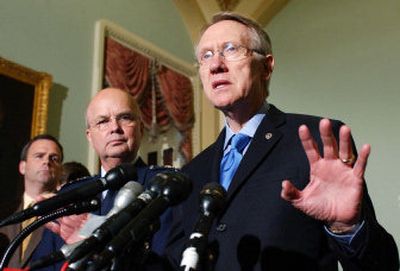
Air Force Gen. Michael V. Hayden, the current nominee to head the CIA, defended the surveillance programs he oversaw as NSA head from 1999 to 2005.
“It’s been briefed to the appropriate members of Congress,” Hayden told reporters outside a Senate office. “The only purpose of the agency’s activities is to preserve the security and the liberty of the American people. And I think we’ve done that.”