
The wound after the bite
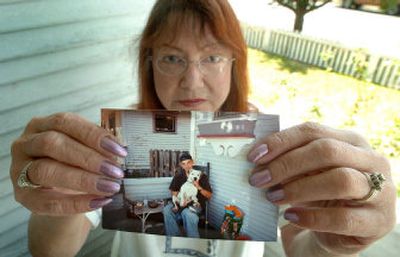
Linda Dunham’s 25-year-old son recently was bitten while attempting to break up a fight between his two dogs at his mother’s home in northeast Spokane.
He went to the doctor for arm punctures while his dogs, both pit bulls, were impounded after his mother called 911 and SpokAnimal CARE.
Because she was the homeowner, Dunham was left with a choice: Pay a $300 fine by Monday to SpokAnimal or be issued a $412 citation and be forced to go to court on criminal charges.
“They told me I might even end up going to jail,” she recalled.
It is a difficult situation apparently faced by many Spokane pet owners. A SpokAnimal memorandum obtained by The Spokesman-Review directs animal control officers to hand out more fines instead of “notices of violation,” so employees could be given pay raises.
In the April 4, 2005, memo, then-SpokAnimal executive Devon Bursch urged fellow employees to hand out more fines.
“You can see that there are fees that we can receive that we are letting walk out the door,” she wrote.
“There has been no money available to give raises since the end of January (2005),” the memo said. “To me this seems easily remedied by getting all your fees paid at the time of service or issuing a (notice of violation) as a last resort.”
A citizens group says this process of pocketing fines instead of issuing court citations is a growing trend by SpokAnimal, though it’s apparently not addressed in the nonprofit organization’s contract with the city.
“There’s nothing in the contract about it,” said Spokane attorney Cheryl Mitchell, whose group has criticized the city’s contract with SpokAnimal.
“Several people who’ve contacted me say they were given a choice of paying a fine to SpokAnimal or having a citation issued,” Mitchell said.
“Some of the citations have a mandatory court appearance and the possibility of an even greater fine,” she said.
“It’s a violation of their police powers to say to someone, ‘Look I’m going to fine you $300, or you can go to court and face the possibility of paying even more,’ ” said Mitchell, a founding member of the Washington State Bar Association’s Animal Law Section.
“They’re attempting to dissuade people from exercising their legal right to due process,” Mitchell said.
In Dunham’s case, paying the fee didn’t save her son’s dogs. She learned when she called to check on their welfare that they’d been euthanized.
Gail Mackie, executive director of SpokAnimal, said the handling of the Dunham case “was strictly by the book,” except she should have been fined even more.
“The $300 was for work incurred by SpokAnimal in housing these animals and putting them to sleep,” Mackie said.
Dunham signed an “owner release,” giving SpokAnimal the authority to impound and euthanize the two dogs, Mackie said.
“If they wanted the dogs back, why didn’t they call us back during that 10-day (quarantine) period?” Mackie said. The dogs could have been quarantined at Dunham’s home, Mackie said, but “she wanted them out of there.”
Mackie said SpokAnimal should have charged Dunham a $110 euthanasia fee for the two dogs and a $35 pickup fee, instead of only the $100 “owner release” fee.
“Everything we’ve done here was to help her,” Mackie said.
But Dunham told a different story Monday on the front porch of her home in the Logan neighborhood. Her son, Ryan Rasberry, has stopped talking to her over the incident, she said.
In a handwritten note, he said he was given “no option” of reclaiming the dogs he’d had since they were puppies.
“This shouldn’t happen to anyone ever again,” he said. “They were by far my best friends.”
Rasberry, a construction laborer, had recently moved back to his mother’s home after his roommates moved out and he couldn’t afford a rental house.
His dogs killed her cat a few weeks after he moved in, upsetting her. “I told him he had to control them at all times.”
When not with him or on leashes, they stayed in Rasberry’s upstairs bedroom, which is where they bit him, apparently while fighting over a rib bone, about 5:30 a.m. on April 30.
When paramedics and three SpokAnimal control officers showed up, Dunham said she didn’t have her glasses on and couldn’t read the fine print on the document handed her by the animal control officers. She thought she was releasing the two dogs for a 10-day rabies observation period.
The same day that her husband, Dennis Dunham, made a $100 payment on the $300 fine, Linda Dunham called SpokAnimal to check on the welfare of the dogs and see if they could be released after the 10-day observation.
“They told me, ‘Oh, the dogs were put down yesterday,’ ” she said. “I was extremely upset.”
Dennis Dunham said being given the choice between the fine or the court citation “was like blackmail. I think it’s outrageous.”