
Sticker shock hits Wall Street

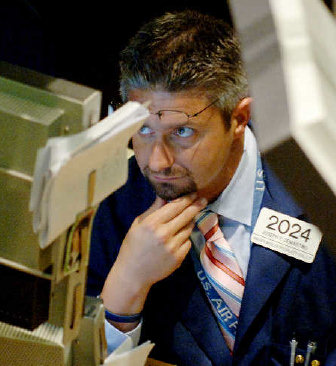
NEW YORK — Just a week after the Dow Jones industrial average climbed toward its all-time high on a wall of optimism, a troubling consumer price report gave Wall Street’s best-known indicator its worst day in more than three years.
The average of 30 blue chip stocks sank 214 points after the Labor Department’s consumer price index delivered evidence that soaring energy costs were driving up consumer prices in other parts of the economy. The report confirmed the fears of a market already on edge from recent signals that the Federal Reserve might have to keep lifting interest rates while inflation pressures persist.
“The CPI data really kicked the market in the teeth today,” said Ken Tower, chief market strategist for Schwab’s CyberTrader. However, he said stocks are now oversold after several days of steep losses, suggesting that investors may start looking for positive signs to spur buying.
All told, consumer prices vaulted by 0.6 percent in April, fueling concerns the Federal Reserve might keep pushing interest rates up to fend off inflation. Discouraged Wall Street investors sent stocks tumbling.
Soaring prices for gasoline and other energy products have played a major role in the spikes seen over the past two months. But the price tags of lots of other goods and services also are climbing.
The increase in the closely watched Consumer Price Index was the biggest jump in three months, the Labor Department said Wednesday. That followed an already strong 0.4 percent advance in March.
“The whiff of inflation is feeling more like a gust,” observed Richard Yamarone, economist at Argus Research. “The inflation picture is worsening.”
Wednesday’s drop was a stunning turn for a Dow average that last week came within 13 points of its best-ever close of 11,722.98, reached Jan. 14, 2000. The market’s advance was fueled by growing expectations that the Fed had accomplished its goal of nudging short-term lending rates until prices showed signs of stabilizing.
But with crude oil pressing record levels and the dollar steadily weakening against the Japanese yen, analysts say it may be time for investors to face the facts: Higher interest rates are inevitable as the global economy continues to expand. Wall Street appears to be coming to terms with the situation, with the Dow shedding 437 points in the last five trading days.
The Dow sank 214.28, or 1.88 percent, Wednesday to 11,205.61, a one-month low. The Dow slid as much as 245.51 points earlier and logged its biggest single-session slide since falling 307 points on March 24, 2003.
Broader stock indicators also declined. The Standard & Poor’s 500 index lost 21.76, or 1.68 percent, to 1,270.32, its lowest close since finishing at 1,262.86 on Feb. 13; the Nasdaq fell 33.33, or 1.5 percent, to 2,195.80, showing a loss for the first time in 2006.
Declining issues led advancers by nearly 5 to 1 on the New York Stock Exchange, where volume of 2.1 billion shares topped the 1.7 billion shares that changed hands Tuesday.
On the inflation front, a growing number of economists said Wednesday’s report raises the odds for another rate increase at the Fed’s next meeting, June 28-29. “I conclude that higher interest rates are in our future,” said Brandeis University economics professor Stephen Cecchetti.
Some, however, still believe the Fed will leave rates alone at the June meeting on the grounds that slower economic growth will eventually ease inflation pressures.