
‘60 Minutes’ pays tribute to Mike Wallace
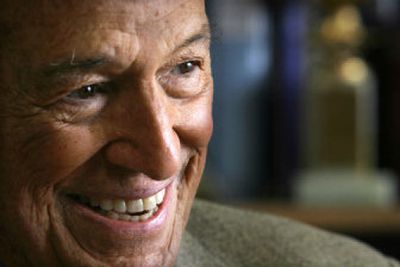
What sets Mike Wallace apart as a broadcast journalist isn’t just that he’s a tough guy, which no one denies.
It isn’t that he’s been around practically forever, although – as someone whose career spans TV’s six-decade history – that’s a factor, too.
No, the truly remarkable thing about Wallace is his seductive gifts as an interviewer. Combat isn’t his preferred style. Coaxing is.
“Look,” he will croon in his rich baritone, as he ratchets up his interrogation another notch. Or: “Forgive me, but ….” Or a simple, insistent: “C’mon ….”
While the voice caresses, the eyes get dreamy, maybe the smile ignites. This is a romancer. And whomever he is talking to, odds are, he will have his way.
He has mostly had his way for 38 years on “60 Minutes,” a spectacular run – some 800 stories’ worth – that began when he was fully 50 years old and a veteran broadcaster.
Wallace, who turned 88 earlier this month, announced a couple of months ago that he was stepping down from full-time correspondent duties.
Hence the retrospective marking his momentous transition: “I’m Mike Wallace: A ‘60 Minutes’ Tribute,” airing tonight at 7 on CBS.
Is he a little bit embarrassed by all the fuss?
“No,” Wallace replies. “I deserve it.”
He laughs, then insists that all the fuss “is about ‘60 Minutes,’ basically. And ‘60 Minutes,’ most of it, has been damn good, down the years.”
During tonight’s program, Wallace revisits his unparalleled career with the guidance of fellow “60 Minutes” hands Ed Bradley, Steve Kroft, Lesley Stahl and Morley Safer.
A gallery of clips displays him questioning everyone from Martin Luther King and Eleanor Roosevelt in his early, pre-“60 Minutes” days, to the Ayatollah Khomeini, Johnny Carson, Ronald Reagan, Yasir Arafat, Jack Kevorkian, Vladimir Putin, Janis Joplin, Manuel Noriega and – his all-time fave – piano virtuoso Vladimir Horowitz, who in 1977 he inveigled into pounding out “Stars and Stripes Forever” on the ivories.
He interviewed Nation of Islam minister Louis Farrakhan, setting the terms with: “You don’t trust the media; you’ve said so. You don’t trust whites; you’ve said so. You don’t trust Jews; you’ve said so. Well, here I am.”
Here he is. Interviewee beware.
“Oh, people know what to expect,” Wallace says. “They know that there’ll be some questions that they’re not gonna be particularly happy with. But they’ll get a chance to give it an honest answer, and they believe – I think, over the years – they’ll be treated fairly, so they get their point of view across.”
Wallace began honing his interviewing skills in the mid-1950s as host of a late-night talk show, “Night Beat,” which aired on a New York TV station and quickly made him a local star.
But already the Brookline, Mass., native was a busy (and versatile) TV personality. In tonight’s retrospective, clips show him in a commercial hawking Golden Fluffo shortening, singing on a variety show and acting on a soap opera.
Then, in the early 1960s, he decided to focus solely on TV journalism. On a Tuesday night in September 1968, he and fellow CBS News correspondent Harry Reasoner bowed as the co-anchors of a new kind of newscast, a “news magazine” that almost no one expected to go very far and few people watched – that is, until it claimed its Sundays-at-7 slot in 1975 and became an institution.
“Working on ‘60 Minutes’ is the best job any reporter could have,” declares Wallace, surrounded in his West 57th Street office by ample supportive evidence: awards, souvenirs, photos of him with a half-century’s worth of giants.
He has no plans to vacate.
“They have told me I could keep this office as long as I’m turning out something,” he says – then, with a mix of majesty and amusement, announces that he has just signed a new four-year contract, thus taking him through his 92nd birthday.
Exactly how much, and what, will he do at work? And how will he spend his unaccustomed leisure?
He doesn’t claim to know yet. Nor, as he faces semiretirement (or whatever this is) does he seem to be sweating it.
“I’m not gonna live a long time,” he ventures to explain. “C’mon! 88? No!
“You kids, you don’t understand, there comes a time when you suddenly say to yourself, ‘Eh, you’re gonna cash it in, in a little while.’ You begin to think about that.”
But clearly he’s thinking about other things, too.
“A remarkable life you’ve had,” his colleague Bradley tells him on tonight’s program.
To which Wallace responds heartily: “And I’m not through!”