
Natural treasures fill Colville
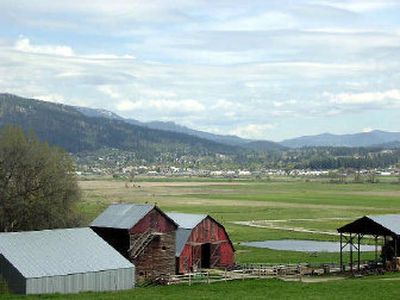

The woods, lakes and rivers near Colville attract outdoorsy types looking for a good hunting spot or a quiet hiking trail.
I can see why. Deer and turkeys are plentiful. We even saw big, pointy doe ears stick out of the tall grass in an empty lot beside our hotel on several occasions last year. And the mountains that encircle the Colville Valley are full of huckleberries and wildflowers.
But the city of Colville has some interesting draws itself – green spaces to play in, a downtown filled with antiques and vintage wares to browse, and a charming museum grounds terraced up a hill at the north end of the town.
And when you’re tired of exploring or just tired of standing in line at the county treasurer’s office (Colville is the county seat), the city’s restaurants offer a variety of choices, including some specializing in uniquely Inland Northwest fare.
On an early fall evening in 1889, smoke rose into the air as rifles and pistols greeted the first train to pull into Colville with a 42-gun salute.
Our arrival on a recent bright, spring day didn’t produce such a reaction. Yet after an hour’s drive in which husband John and I consumed about half a pot of coffee each, the cluster of buildings at the north end of the Colville Valley seemed welcoming.
We descended the Huckleberry Range into the green fields that spread out over the valley floor. Streams and creeks crisscrossed the flat pasture and farmland.
When we reached Colville, our first and most critical stop was at Yep Kanum Park (also known as Colville City Park). The park has public restrooms – thank goodness, after all that coffee.
Bounded by tall trees, Yep Kanum Park is a cool, shady 18 acres where you can picnic, toss horseshoes or play tennis.
For 10-year-old Kimberly Krieger it’s also a good place to practice ball with her older sister before an upcoming first game, and to spot birds.
“Hey, do you want to see an owl?” she asked as we walked our dog, Kah-less, along a cement path. Kah-less thought she was going to ask to pet him; he was disappointed that it was some birds getting all the attention.
Kimberly’s sister Heather, 14, said it was the first owl she had ever seen. We tilted our heads back and used our hands to block out the sun while we tried to find the pair of owls roosting way up in the shadows of the needled branches.
Yep Kanum Park is a popular hangout for lots of birds, including a pair of merlins, also known as pigeon hawks, according to Tricia Woods, manager of the Colville Chamber of Commerce.
“Everybody goes crazy when they fly through,” she said of the merlins.
Woods has a long list of things to do in and around Colville in addition to bird watching. Stop in the chamber office at 121 E. Astor for brochures, maps and information on seasonal activities.
At the park’s south end, we wandered beneath a tall, coniferous canopy. Violets encircled several trees. Birdhouses hung on an old burned trunk, now hollow and dotted with holes. We wondered how many birds call this blackened column home.
After our walk, we parked downtown at “The Rickey Block,” named in memory of John Rickey, one of the first traveling salesmen in these parts, I’m guessing. In the late 1860s, Rickey moved up and down the Columbia River to serve early settlers, plus soldiers and officers near Fort Colville.
He later invested $18,000 in a three-story building in Colville which has likely been the site of some fascinating history, especially the top floor. Rooms there were the scene of courtship and romance for community dances, lodge hall meetings for Masons and Eagles, chambers for the city council, a classroom for students interested in learning shorthand and bookkeeping, and a courtroom for Superior Court. In 1895, it was the setting for a murder trial.
David Barman opened a store in the ground floor, and a nephew and son continued the business until 1987. Today, the name Barmans appears on the window in shiny, gold letters. The building was restored by new owners and placed on the National Historic Registry in 1995.
On the day we were there, Johnny Cash’s voice sang out “Ring of Fire” as we circulated among cases of china, vintage jewelry and toys. Sauces, spices, jams and novelty foods lined cabinets in the center of the store. Antique furniture, clothes and tools filled the whole building.
A three-legged cat greeted John as he stooped to get a closer look at a set of four cups and saucers – no cracks or damage. The china’s orange poppies reminded me of my grandmother, who had only a few pieces in this same pattern to pass along to my mother and to me.
Barmans also serves soup and sandwiches, ice cream and chai tea. Homemade fudge is a specialty; a banner strung in the window advertised it being “made with real cream and butter.”
We took our sandwich and soup down the street to an open courtyard where we ate lunch with Kah-less. For dessert we pinched pieces from a half-pound block of peanut-butter fudge. (Only half a pound, not a whole – I do have some restraint.)
If you’re there on a weekday, you might want to try The Courthouse Cafe. Logically situated across from the county courthouse, the small eating place features fresh lunch items and desserts.
For something extra special, make reservations at Lovitt’s, located in an old farmhouse off Highway 395. The menu focuses on regional food and wines, making use of homemade pastas and local, organically grown produce and ingredients.
Before we left town, we stopped at the grounds of the Keller Heritage Center Park to look around.
It was poised for spring. Stiff, green blades spilling down a hill would soon hold purple iris heads, and labels under a shade tree beside the Keller House promised summer flowers.
The Keller House, a craftsman bungalow built in 1910, rests atop the green hill, a centerpiece of the grounds.
Colville’s first schoolhouse, a homestead cabin, and a shed filled with early farming and blacksmith tools sit below the house. An original 1950s fire lookout towers above the museum grounds.
Near the house, a collection of rock and cement art, known as the “Hixon Castles,” make up an amusing garden.
Along with exhibits on area history, the Keller Heritage Center is host to “Between Fences,” a Smithsonian traveling exhibit, through June 18. The exhibit takes a close look at fences in American culture, from the home-sweet-home symbol of the picket fence to the barbed wire that played a part in the struggle over grazing land.
We returned to Colville a week later to donate some old books and games to one of the local thrift stores. Maybe it was more like an exchange – we left with a used tackle box, a flower pot and other treasures.
Oh, and since we were in the neighborhood, we thought we might as well get a half-pound of fudge. (Just a half pound, not a whole – I do have some restraint.)