
The game has changed
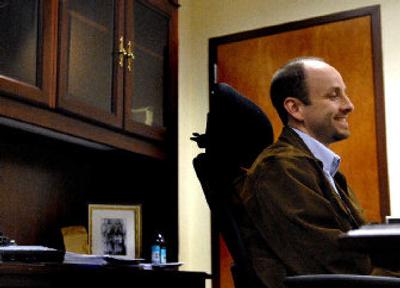
WORLEY, Idaho – David LaSarte-Meeks always had a hankering to return to his roots on the Coeur d’Alene Indian Reservation, but job offers usually pulled him away.
He worked as an engineer in Washington, D.C.; as executive director of the Arizona Indian Gaming Association in Phoenix; and as an attorney in Seattle.
Last month, another job offer led him home. LaSarte-Meeks, 35, is the new CEO of the Coeur d’Alene Casino & Resort.
The Stanford-trained attorney and MBA has never a run a company before, let alone one that employs 830 people and generated roughly $28 million in profits last year. But he cites a diverse resumé and strong desire to see the casino succeed as qualifications for running the Coeur d’Alene Tribe’s largest business venture.
“I’m a tribal member,” LaSarte-Meeks said. “I have a lot of family in the area, and I know how important the casino is to the tribe and to the community.”
The casino is one of Kootenai County’s largest employers — plus so much more. Over the past decade, it’s rebuilt the fortunes of the Coeur d’Alene Tribe, reducing poverty on the reservation and helping the tribe achieve political and economic prominence in the Inland Northwest.
About 30 percent of the casino’s workers are Native American. Twice a year, a portion of the casino’s profits are distributed as dividend checks to tribal shareholders, arriving in time to buy school clothes and Christmas presents.
“We’re much more conscious of the fact that we want to run a socially responsible business,” LaSarte-Meeks said.
Though LaSarte-Meeks has never run a company, he said he has lots of other management experience. In Arizona, he helped negotiate tribal gaming pacts. He also served as spokesman and treasurer for a $25 million state ballot initiative on tribal gaming in that state. During a one-year stint as the Coeur d’Alene Tribe’s interim housing director, LaSarte-Meeks also led the effort to build a senior housing complex.
“His resumé clearly spoke for itself,” said Chief Allan, chairman of the Coeur d’Alene Tribal Council. “He’s run gaming interests for 19 tribes in Arizona.”
LaSarte-Meeks is taking the reins after a tumultuous period in the 13-year-old casino’s history.
The former CEO was fired in late May. The tribal council was initially tight-lipped about the departure of David Matheson, who had led the enterprise from its beginnings as a small bingo hall to a multimillion-dollar casino-hotel-golf complex. Later, the tribe sued Matheson for breach of fiduciary duties.
The suit, filed in tribal court, cited a $684,000 severance package that Matheson paid to the casino’s former chief operating officer, who was forced to resign after racking up more than $100,000 in undocumented expenses on company credit cards. Matheson tried to hide the payout from the tribal council, because he knew the council wouldn’t approve, the suit said.
Matheson has said he plans to file a counter-suit. He’s also gathered signatures for a referendum election that would amend the tribe’s constitution to funnel casino profits into $1,000 monthly payments to all enrolled tribal members.
The issue has been divisive. Some support Matheson’s proposal; others support Allan and the council, who have said such payments would financially undermine the casino.
To the credit of the Coeur d’Alene Casino’s employees, the business continued to operate smoothly following Matheson’s departure, LaSarte said. The casino ended its fiscal year on Oct. 31 with record profits.
“It’s such a large organization that there’s a strong management team,” he said. “It’s been successful without a CEO for the past six months.”
LaSarte-Meeks doesn’t see a role for himself in political discussion surrounding how casino profits should be spent. The Coeur d’Alene Casino is sort of like the state lottery, he said. The CEO’s job is to focus on running a profitable organization; how the money is spent is a policy call for the council and tribal members, LaSarte-Meeks said.
“I think one of the roles of a CEO is to shield the employees and the management team from politics,” he said, “and to keep the politics out of the business and the business out of the politics.”
LaSarte-Meeks spent his early years in North Idaho, graduating from high school in Alaska. He studied civil engineering at Brown University and worked as a project engineer for an environmental firm on the East Coast.
Watching the casino’s growth prompted him to earn graduate business and law degrees from Stanford University, LaSarte-Meeks said.
He and his wife, Myra Parker, most recently lived in Seattle, where he worked for a small law firm specializing in Indian treaty and gaming issues. Parker is finishing up a doctorate in public health at the University of Washington. The couple has a 13-month-old daughter.
Part of the attraction of returning to North Idaho is the professional challenge of working with an organization at a crossroads, LaSarte-Meeks said.
Even as managers discuss future expansion plans — “our hotel is often at capacity, and our gaming floor is often at capacity,” LaSarte-Meeks said — they’re mindful of looming competition from other tribes. The Kalispel Tribe operates a successful casino in Airway Heights, and the Spokane Tribe also plans to build a gaming operation there.
The Coeur d’Alene Tribe supports other tribes’ efforts to develop gaming facilities, Allan said.
But increased competition will affect how the Coeur d’Alene Casino positions itself in the entertainment market. LaSarte-Meeks said he wants to do some demographic studies, to gain a better understanding of the casino’s audience.
The Coeur d’Alene Tribe also wants to diversify the reservation economy. In addition to an RV park at the casino and another hotel wing, the tribe wants to develop a 160-acre business park north of the casino.