
Chinese students study language
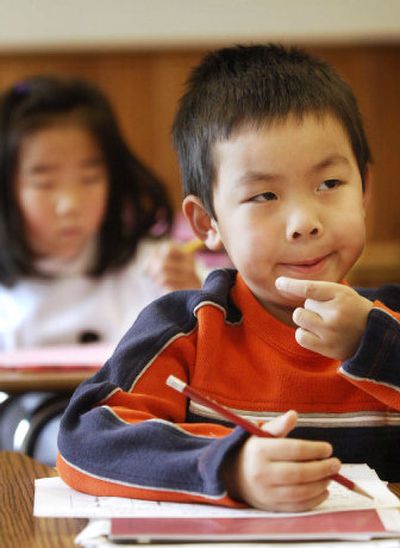
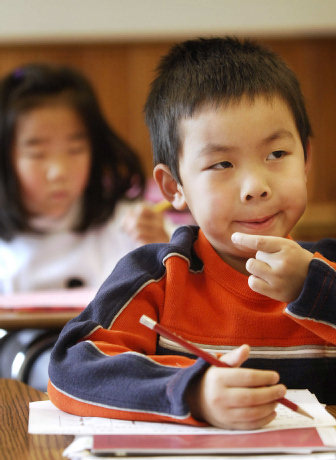
At 13 years old, Kevin Ma could probably think of a few things he would rather be doing on a Saturday afternoon, but nothing as important to his family and his community as learning his father’s language.
“No matter where you go, it is important to keep your cultural identity,” Kevin said. “Keeping Chinese culture alive in a community with so few Chinese people” is what motivates him.
It helps that it’s not just his father’s language; it’s his father’s school.
Fenggang Ma, an environmental engineer for the state of Washington, is principal of the Chinese Language School in Spokane.
Every Saturday, Kevin and about three dozen other children between the ages of 5 and 15 attend classes from 1 to 3 p.m. at Gonzaga University’s Administration Building, which donates the classroom space.
Most of the students are the children of Chinese immigrants, including GU and Eastern Washington University faculty. About a third of the students are the adopted Chinese children of American parents.
“They need to be aware of and part of their culture,” said Patrick Jones, whose adopted daughter, Melissa, 8, is attending Chinese school for the third year.
Jones, executive director of EWU’s Institute for Public Policy and Economic Analysis, believes it is critical for native-born Chinese children to have a connection to their culture.
“Language is the major avenue toward culture,” added Jones, who said there are about 200 adopted Chinese children in the Spokane area.
Even for the most motivated of students, Mandarin Chinese is not easy to learn.
“A student must grasp about 3,000 Chinese words to read an average novel or a newspaper,” Ma said. Students in his son’s class, the most advanced in the school, know perhaps 350 words.
“You can’t just do it for fun,” Ma said. “You have to really want to learn.”
The cost of classes is $100 per student per semester. There is a discount for families with more than one student. Ma said it would cost much more if not for the generosity of the university and the sponsorship of GU philosophy professor Liu Quan Hua.
The nonprofit school was founded four years ago by the Spokane Chinese Association, according to the group’s president, Ping Ping, when members Jiang Qing Gong and Jing Qiu Liu rounded up enough teachers.
Chinese immigrants in Spokane number about 1,200, Ping Ping said.
Qian and Thomas Godon have two children in the school, Matthew, 8, and Sarah, 6.
It is important to Qian Godon, whose family still lives in China, that her children maintain their cultural identity and that they be able to speak Chinese when they call her relatives.
She also hopes it will help them find a job later in life.
Godon and other parents are very aware that as China’s role in the global economy emerges so too will the Chinese language.
Chinese instructors are in high demand at high schools across the United States, Jones said. He worries how Melissa will be able to continue her studies when no high school in the Spokane area offers Chinese.
Kevin Ma hopes his language skills will help him get into a good college. It’s hard to give up his Saturday afternoons, he said, but it’s worth it.
“The best part of being Chinese,” he said, “is being able to show off your culture.”