
FOOTAGE
A documentary produced by a professional film crew following the rampage of a man-killing Siberian tiger was named the grand prize winner at the 31st annual Banff Mountain Film Festival that wrapped up last weekend in Banff, Alberta.
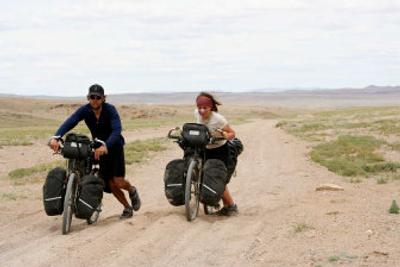
However, a pair of adventure cyclists using a hand-held minicam to document their grueling 8,000-kilometer trip from Mongolia to Nepal won the coveted People’s Choice Award at the nine-day event.
Both productions and many more spirited outdoor pursuits are scheduled for showing in Spokane next weekend as a selection of up to two dozen top Banff festival films hits the road for a World Tour. Traveling films will cover a wide range of outdoor pursuits, including climbing, paddling, wildlife and quirky short subjects from creative minds.
The tour will stop in Spokane Friday, Saturday and Sunday at The Met, with a different selection of four or more films at each showing. Since Spokane is one of the first stops on the tour, the complete lineup of films was not available in time for publication, but tour organizers had some educated predictions.
There’s no shortage of good material to please viewers, said Phil Bridgers, who attended the festival in Banff and viewed most of the 60 films presented during the Oct. 28-Nov. 5 festival.
“Overall, I’d say the quality of climbing films really stood out this year, but there’s so much more,” said Bridgers, spokesman for Mountain Gear, which sponsors the World Tour visit to Spokane. Here are his comments on several films that are likely to be shown in Spokane.
Conflict Tiger (grand prize winner): A team of English and Swedish filmmakers document the pursuit of a Siberian tiger suspected of killing two men. The film pits the pressing demands of human survival against an endangered species and a threatened environment.
“Poachers wounded this tiger,” Bridgers said. “It was shot twice, once with a rifle and once with a shotgun, and it was really pissed off. So it turns on a small village, and one man in particular. It’s a re-enactment with a lot of original live footage as they tracked the tiger and found the bodies. It’s pretty tense.”
Asiemut (People’s Choice Award): Canadians and first-time filmmakers Olivier Higgins and Mélanie Carrier find wonder, hardship and discovery as they document their 8,000-kilometer bike tour from Mongolia to Nepal.
“This film says everything about adventure travel and average people taking on huge expeditions,” Bridgers said. “You really get a feel for it as they huddle curled up in a ball during a sandstorm. They had sand in their bodies and bikes in places you don’t want to have sand.”
Patagonia, A Travel to the End of the World: Norwegian adventurers Borge Ousland and Thomas Ulrich display their mastery of various outdoor skills to film their 67-day self-supported traverse of the southern Patagonia Icecap.
“These guys are amazing, and their film shows their hard work as well as their humor,” Bridgers said.
“They start in kayaks, each of them towing a separate kayak loaded with gear. Then they ditch two of the kayaks and take off on cross-country skis towing the gear kayaks as sleds. Even when they are doing technical climbing, they haul up the kayaks. Then they finish the trip by leaving unneeded gear and paddling the kayaks to a village.”
Heartbeats of Denali: This Canadian film pulls back from the drama of climbing North America’s highest peak to focus on the fragile life in its wilderness lowlands through the four seasons.
“Climbing is my passion, but I liked this different perspective of the mountain,” Bridgers said.
Aweberg: Two Canadian climbers and a cameraman make a daring and somewhat foolhardy attempt to climb icebergs.
“Experts say you’re nuts to climb icebergs and this film shows why,” Bridgers said. “They pull up to a berg in their boat, the climber swings his pick and the ice makes a popping sound. You can see him freaking out as he climbs because the ice in a berg is under pressure and it cracks every time you swing the pick. It’s pretty intense.
They climbers film some of their own stuff when the cameraman is seasick. In one case, they finish climbing a berg and as they get on the boat, a chunk of ice the size of a school bus cracks off and falls into the sea. It’s the exact place he was climbing just minutes earlier.”
Short films are perennial crowd pleasers on the Banff films World Tour, and this year will be no exception, Bridgers said.
“They have been editing the major films to shorter lengths for the tour so we can offer more films in a showing, but the films that are designed to be short can really be fun. In particular, I liked a six-minute film that looks back at the beginning of bungie jumping, which started with some African natives who leap off high places after tying vines to their ankles. That’s not the worst of it. To prove their manhood, they get circumcised before they jump. And, yes, sometimes the vines break. Talk about a bad day.
“Another neat short film uses a camera rigged in a bird box in the Great Lakes region to show how a bunch of newly hatched ducklings get the courage to jump 20 feet down to the water.”
As always, the heart-thumping collections of short clips used to introduce the World Tour showings entices viewers with dramatic moments from the films entered in this year’s film festival competition.
“One clip in particular grabbed me,” Bridgers said. “An ice climber 60 feet up on a massive ice pillar swings his pick and the whole thing breaks off. I’m glad I went to the festival and saw the whole film to learn that the guy survived. You’d never guess that by looking at that clip.”