
Pressures mount on Bush for new tack in Mideast
WASHINGTON – President Bush came under new pressure Monday at home and abroad to alter his policies in the Middle East. British Prime Minister Tony Blair pushed for a broader Middle East peace initiative to help stabilize Iraq, while the incoming chairman of the Senate Armed Services Committee pledged to take a hard line on seeking early troop withdrawals.
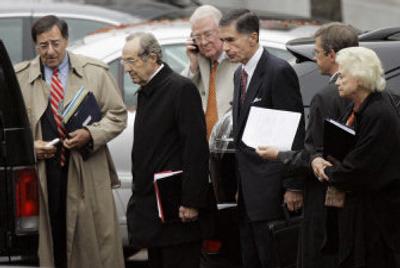
Bush offered little indication he is planning to adjust his approach, telling reporters gathered in the Oval Office that “the best military options depend upon the conditions on the ground” in Iraq. The president also met for more than an hour with former Secretary of State James A. Baker III, former Rep. Lee H. Hamilton, D-Ind., and other members of the bipartisan Iraq Study Group, which is looking to chart a new course in the war.
Asked about calls for dialogue with Iran and Syria to help curb violence in Iraq, Bush said there was no change in his position that Iran first must suspend uranium enrichment. “Our focus of this administration is to convince the Iranians to give up its nuclear weapons ambitions,” Bush said after a meeting with Israeli Prime Minister Ehud Olmert.
Bush and Olmert told reporters they spoke at length about how to persuade Iran to abandon its nuclear ambitions. “There is no question that the Iranian threat is not just a threat for Israel, but for the whole world,” Olmert said.
The day’s events underscored the rapidly evolving political landscape for the White House, which finds itself trying to balance the desire for change voiced by the electorate last Tuesday with the president’s frequently stated conviction that the United States must remain engaged militarily in Iraq until the government there can maintain its own security.
The White House will also have to deal with a Congress controlled by Democrats, a difference highlighted by Sen. Carl M. Levin, D-Mich., as he outlined the new agenda of an Armed Services Committee that for the past four years has been largely deferential to Bush’s conduct of the war. Levin plans to step up the committee’s activities, reviewing the state of military readiness and conducting more oversight of such issues as the rendition of terrorism suspects to countries suspected of practicing torture.
Levin also served notice that he intends to take a strong line on withdrawing U.S. forces from Iraq, telling reporters that he thinks a slim majority of the Senate may back his call for a “phased redeployment” of more than 140,000 U.S. troops.
“We had 40 senators who voted that way essentially six months ago, roughly, and there may be 50 or 51 senators that will vote that way now,” Levin said at a news conference, referring to a bill that would call on the president to inform the Iraqi government that U.S. forces would begin leaving Iraq in four to six months.
In London, meanwhile, Blair suggested a desire for a more aggressive Western initiative to resolve the Israeli-Palestinian conflict as a key to tamping down violence in the region, a recommendation also reportedly under consideration by the Iraq Study Group. Blair said resolving the Arab-Israeli dispute, new steps to stabilize Lebanon and other steps outside Iraq are necessary to curb militancy inside the country.
“A major part of the answer to Iraq lies not in Iraq itself but outside it, in the whole of the region where the same forces are at work, where the roots of this global terrorism are to be found, where the extremism flourishes,” said Blair.
Blair is scheduled to amplify his views Tuesday in a private videoconference with members of the Baker-Hamilton group, which will soon begin deliberating specific recommendations following months of interviews with senior policy-makers in America, Iraq and elsewhere.
The White House was extremely guarded Monday about the round of meetings the study group held with Bush and other members of his administration, including Secretary of State Condoleezza Rice, national security adviser Stephen J. Hadley and Vice President Dick Cheney. Bush said he was not going to “prejudge” the group’s report, which is expected in early December. He said they had a “really good discussion” and said he was looking forward to “interesting ideas.”