
Nissan Quest gets midcycle touch-up
Nature fills vacuums and designers fill spaces.
Depending on your point of view, nature is either unfailingly correct in its choices or prone to horrific mistakes. There’s no such question about designers.
They make mistakes.
Nissan admitted as much when it gave us the revised 2007 Quest minivan. For the most part, the Quest is essentially untouched. But conspicuous in its absence is the round pedestal that once housed the Quest’s control panel and filled up a healthy chunk of forward cabin space.
“I know,” some designer must have said; “there’s some empty space; let’s fill it up.”
And so they did. But whatsoever Nissan giveth, Nissan may also taketh away, and now the pedestal is no more.
As the pundits might say, it was a polarizing concept, but I liked it. It was fresh. It was different. It was creative and new.
Admittedly, it was a little clunky in execution and, worse, it relegated the gauge pod — including the speedometer — to the center of the dash. There can be just one suitable location for the speedo — directly ahead of the steering wheel, where it sits in the driver’s line of sight.
Even so, any effort to break out of the mold should be applauded. Props to Nissan for the effort.
Besides, I thought the tabletop structure offered a nice design metaphor; its sloping surface echoed the 3-D “bird’s-eye” view of Nissan’s navigation system, itself a metaphor for the way we view the world.
But buyers responded with a shrug — or worse —and so it was back to the drawing board for ‘07.
What we have now is a perfectly acceptable — though still not entirely conventional — interior layout. The gauges are back where they belong, in front of the driver, and the space they once occupied on top of the dash now does duty as the display/nav screen.
The instrument panel, though more conventionally positioned, retains elements of its former circular self and is trimmed either in wood-grain or metallic-finish.
Not willing to bow completely to tradition, Nissan’s designers located the short shift lever here, too. It juts out from the IP, where it is right at the driver’s hand.
The dash now forms a smooth and contiguous surface.
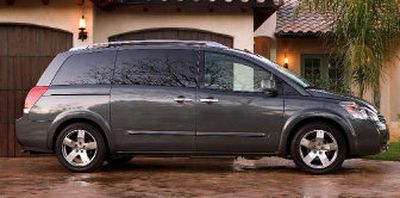
A set of exterior upgrades complements the new interior design, though they are nowhere near as emphatic. Up front, the redesigned bumper, headlights and grille better reflect the family design aesthetic. The door handles are chromed, as is the roof rack.
The humble minivan goes uptown.
All Quests, which start at $25,350 and top out at $38,000, are powered by a 235-horsepower, 3.5-liter V-6. Variable valve timing lends a broad, flat torque curve, which becomes an important asset when you’re loaded to the gills and might just go buggy if you can’t get around the RV ahead. Be aware: Premium fuel is required.
Ride and handling are a cut above the norm, due to a suspension that’s shared with such sporty rigs as the Altima sedan and Murano crossover. Ignore anyone who tells you it’s the sport sedan of minivans, though: Fling the Quest into the tight twisties or around a fast sweeper and it will reward you with the body lean you’d expect from a tall wagon.
More to the point, the Quest retains its composure when crammed; it never wallows or feels flabby on its feet. The steering is sharp and responsive, although a little less communicative than it might be.
Anti-lock brakes are standard, and include brake assist and electronic brake-force distribution, another big asset with a loaded vehicle. Nissan even throws in a full set of airbags, including curtain-style bags.
Sightlines from the driver’s seat are excellent and improvements in noise, vibration and harshness enhance the livability factor. The Quest’s seats are good, the cabin is quiet and comfortable and the seating arrangements flexible enough to handle most situations.
The usual run of options is available, as one that deserves a little extra attention.
Nissan’s SkyView four-panel glass sunroof is like having a skylight for your minivan. As the Realtors say, it’s light and bright in there. Unfortunately, it’s only available on the top trim levels and only as part of a $3,200 package, which can only be ordered in conjunction with the $1,550 Entertainment Package or the $4,050 Premium Package.
So, it’s cool. But only if you can afford it.
If automakers have learned anything about minivan drivers over the years, it’s that they cherish practicality. They appreciate usefulness and efficiency and, yes, predictability.
They have voted time and again with their wallets: Don’t confuse us with unnecessary design flourishes and don’t fill up that space just to fill it. Keep it simple and give it to us straight. We can take it.