
LIT UP FOR KIDS
Maybe it’s the cold, dark winters. Or the damp springs.
Something in the water, perhaps?
What else could explain the uptick in the number of children’s book authors in the Inland Northwest?
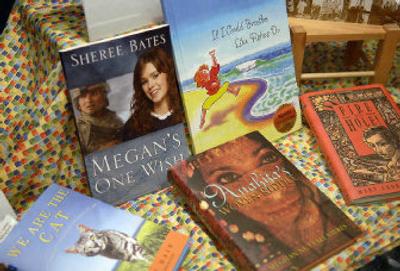
At least six children’s writers from the region had books released from national publishing houses this fall. It’s a trend that local writers and booksellers say sheds light on a vibrant kid-lit scene.
“I’ve said it for years. Spokane is a hotbed of children’s authors,” said Kenn Nesbitt, who co-authored the poetry collection “Santa Got Stuck in the Chimney.” “I don’t know why.”
The trend hasn’t escaped the notice of other book watchers. Lindsey Reiswing, children’s department buyer, manager and event planner for Auntie’s in downtown Spokane, noted that “this fall has been pretty packed with local Spokane authors.”
Reiswing said that having a book released in the fall is a strategic decision. Publishers put out their most promising books for the holiday season, just as movie studios put out their most promising films closer to the Oscars.
Joining Nesbitt’s book on the fall publishers’ lists are Beth Cooley’s “Shelter,” Claire Rudolf Murphy’s “Children of Alcatraz,” Kelly Milner Halls’ “Tales of the Cryptids,” Michael Harmon’s “Skate” and Meghan Nuttall Sayres’ “Anahita’s Woven Riddle.”
No one can point to one flash point, one reason, one conduit for the boom in kids’ books locally. The Get Lit! project and Eastern Washington University’s creative writing program both get credit for generating interest. Bookstores such as Auntie’s and Children’s Corner offer support, as do area schools and libraries.
Several authors, however, give a nod to those who came before.
“It really started with Terry Davis,” said Milner Halls, referring to the Spokane native whose first novel, “Vision Quest,” was nominated for an American Book Award in 1981 and was made into a major motion picture. “That would be the genesis.”
One thing the Spokane scene has is a tradition of mentorship, Milner Halls said. She’s been helped by Chris Crutcher, author of more than 10 young adult novels, who in turn worked with Davis.
“We do support each other and we are welcoming to those we meet who are new,” Rudolf Murphy said. “Writing can be a lonely job. Ultimately, it’s just you and the page. So it’s wonderful to have a community” of writers to listen to, learn from and lend support.
The Society of Children’s Book Writers and Illustrators is one vehicle authors use to get support, said Deby Fredericks, the group’s regional advisor.
“We do have a really great group of established professionals who are willing to help out newcomers,” she said.
Up until a couple of years ago, the society’s only Washington chapter was based in Seattle. The new Inland Empire region includes writers and illustrators from Eastern Washington and North Idaho.
The group holds meetings and conferences to help writers and illustrators navigate the publishing world and perfect their craft. It also sponsors critique groups, in which writers can share their work with others.
That feedback is critical, Fredericks said.
“You read things to your family and of course they love it all,” said Fredericks, who writes juvenile fiction as Lucy Ford and adult fantasy under her own name.
Rudolf Murphy, who is part of a critique group, agrees.
“I’m really blessed that I have a terrific writers group here,” she said.
Writers decide to create books for children for various reasons. Fredericks likes that children’s books take less time.
“I can say ‘I can finish this,’ ” she said, “and that is a big deal for a writer.”
Several other local authors point to their own children as the creative spark.
Cooley started writing young adult books when her two daughters were in their early teen and “‘tween” years.
“I started reading what they were reading,” she said. “And I found that it was so much more fun to read.”
She remembers that as a middle-schooler she had a hard time finding books to read.
“I wanted more books like ‘Harriet the Spy,’ ” she said.
Some are drawn to the children’s genres because it seems more doable than adult fiction or adult memoir, Rudolf Murphy said. Several of the authors said they often hear from people who want to jump into the children’s book world.
“I’m amazed at the number of people who tell me ‘I’ve always wanted to write a children’s book.’ But they don’t,” Nesbitt said. “That’s the biggest challenge.
“I like to draw the analogy of getting your garage band singed to a major label,” he said. “First you have to write a book and then you have to get it published. The good news is that cream rises. Look at Spokane authors such as Jess Walter. He’s a phenomenal writer. He deserves all the praise he’s getting.”