
The real Ashton Kutcher
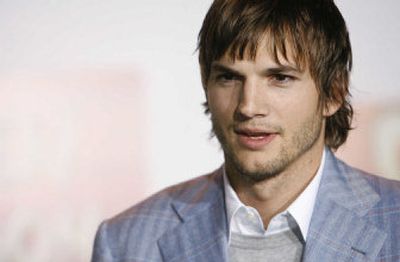
Is Ashton Kutcher a dim pretty-boy?
That’s what people wonder. He’s played dim pretty-boys to such perfection in television and film – starting with Michael Kelso, the naive but likable character he portrayed for seven seasons on “That ‘70s Show” – that the line between fantasy and reality starts to blur.
Then there’s the whole Demi Moore thing. Is there something beside his fabulous good looks that made a 40-year-old movie star with three kids and a quiet home life in Idaho fall for and marry a kid 15 years her junior?
So when Kutcher, now 28, rolled into Washington for the premiere of “The Guardian” – which opened Friday – it was intriguing to meet him, up close and personal, the afternoon before his big red-carpet appearance drew legions of shrieking female gawkers and tied up rush-hour traffic.
As far as first impressions go, he can be something of an endearing goofball, spilling the soft drink he graciously offered to fetch for his guest.
Then, over the next 45 minutes, he proceeded to talk about his production company, his Internet development deal, his onetime plans to study biochemical engineering at MIT, and how his MTV show “Punk’d” is, he hopes, more a study of human nature than it is “Candid Camera” with celebrities.
That didn’t even touch on Dolce, the Hollywood restaurant hot spot he invested in, or the deal he just signed with MTV to produce a reality series following Oscar-winning rappers Three 6 Mafia.
More than anything, what’s striking about Kutcher is how at ease he is, how little outside perceptions affect him. He’s funny and self-deprecating and wholly realistic.
“When you invent a character, then you have to struggle to change people’s perceptions of you, because it comes with a preconceived notion,” Kutcher says. “But I think (Sir Laurence) Olivier said that a wealthy man can always play a beggar, but a beggar can never play a wealthy man. …
“I think you’re kind of always trying to move on. You try to push it and you wait for people to sort of catch up to you.”
Touchstone Films is gambling that audiences will catch up to the idea of Kutcher as not just a dramatic leading man, but an action hero.
In “The Guardian,” he plays Jake Fischer, the top trainee at the Coast Guard’s elite “A-School” for rescue swimmers. Kevin Costner co-stars as an instructor.
Kutcher wanted in on this movie for 31/2 years, but it wasn’t until director Andrew Davis (“The Fugitive,” “Collateral Damage”) and Costner signed on that the project got the green light.
Even then, the studio seemed hesitant to sign Kutcher. But after a breakfast meeting, Davis was immediately wowed.
“First of all, he’s a great-looking kid,” the director says. “But he was very committed to doing it right and making it real. And he’s very smart. He’s going to be hugely in demand. He’s going to have a huge career, this kid.”
The next hurdle, Davis says, was convincing Costner the relationship would work, because “I think all Kevin knew about the guy was the ‘That ‘70s Show’ character and the fact that he was married to a big movie star.”
Costner confirms all this. But what he ended up seeing, he says, was an actor playing a very difficult part very well.
“It’s not easy to do comedy and it’s not easy to do the good-looking buffoon, because we’ve seen people try to do that all the time and fail,” Costner says – pointing to John Travolta as Vinnie Barbarino on “Welcome Back, Kotter” as an example of someone who did it brilliantly.
“It’s very hard in this world to think that people are diminishing you because you play a vain, kind of goofy character, so to speak. If that’s how you’re going to look at Ashton, then you’re probably going to think that I came in second place at the U.S. Open based on ‘Tin Cup.’ “
In order to be believable as a top-notch swimmer, Kutcher put himself through eight months of personal boot camp, adding more than 10 pounds of muscle to his frame and swimming laps weighted down with heavy equipment. He also gave up smoking.
Once filming started, though, the real challenge for Kutcher was the character development.
What, exactly, made his character the aloof elitist he had become? Kutcher confided in Costner that he was concerned because Jake’s back story had yet to be determined in the script.
He knew something traumatic had to have happened to his character, so he decided to take a page from his own life and use it as his motivation.
He decided to act from an experience he had at 18 – to relive the fallout from the one night when he really was a bonehead.
Born Christopher Ashton Kutcher (he was known as Chris until his modeling career took off), Kutcher has an older sister as well as a twin brother, Michael, who was born with health problems and had a heart transplant at age 13.
He grew up in tiny Homestead, Iowa, population approximately 100. His parents were both factory workers, dad Larry at General Mills, and mom Diane at Procter & Gamble. They divorced when he was 14, but he remains close to both of them.
He also formed a friendship with his high school principal, Tom McDonald.
“He could be silly, but Chris was a brilliant young man,” says McDonald. “He would act goofy dumb and we’d just have fun.”
Most of Kutcher’s antics were harmless. But there was one big exception.
“I was 18 and I was a really good student and a good kid, and didn’t get in trouble, and then I broke into my high school,” Kutcher says matter-of-factly.
He broke in with a cousin in the middle of the night. They set off a silent alarm and Kutcher was caught trying to get away. He spent the night in jail, and eventually was convicted of third-degree burglary and sentenced to 180 hours of community service and three years’ probation (his record was later expunged).
At the time, he had been anticipating acceptances to both MIT and Purdue to study engineering. He had been a football player, a star in school plays, a well-liked, popular guy everyone expected to be one of the town’s success stories.
And suddenly he was the town outcast.
“You’d walk down the street and feel people looking at you like, ‘Oh, that’s the kid that broke into the high school,’ ” he says. “Then my girlfriend broke up with me. Then I lost my college scholarships and got kicked out of the National Honor Society and the choir and the play. …”
Looking back, Kutcher calls the experience “the best thing that could ever have happened to me.
“Getting in trouble, learning a life lesson – it straightened me out pretty quick,” he says.
At the time, though, he was miserable. He was banned from the prom and other activities, but allowed to graduate – and did so in the top five of his class.
He wound up at the University of Iowa, and at 19 entered a “Fresh Faces of Iowa” modeling competition on a whim – the big prize was at trip to New York City, and he’d never been to the East Coast – and won.
Once he got to New York (“I had to get permission from the judge,” he says, referring to the terms of his probation), he realized he could get work as a model and make some decent money, so he decided to stay, and chucked the whole engineering thing.
Back home, people thought he was pretty much nuts.
“They thought I was making a pretty foolish choice, and they’ve since sort of told me that,” he says. “And, in some ways, I probably was making a foolish choice. But most of the great things in the world come from really illogical decisions.”
Like his marriage. “Absolutely 100 percent illogical” is how he describes his decision to get involved with Demi Moore in the spring of 2003. (They wed last September.)
Illogical?
“Well,” he says, “I was 25 years old. I’m hosting ‘Saturday Night Live.’ I’m on the cover of Rolling Stone. I’ve got the number one movie in America (‘Just Married’). Let’s tie myself down! Let me really get tied down, right now!”
He leans in with a look that’s part amusement, part self-satisfaction.
“I don’t think, for most people, that would be a logical decision. And for me, it definitely wasn’t a logical decision. But it’s a decision that I couldn’t help making.”
And what was it about Moore that led him to give up all that youthful freedom to become a twenty-something husband with three stepdaughters?
“When you find it,” he says, “you’ll know.”
As Kutcher sees it, life is good these days.
“I’ve already achieved more than I ever expected,” he says, spreading out his arms. “Anything else is a bonus.”
In addition to “The Guardian,” Kutcher has a second movie opening this weekend. In “Open Season,” an animated film, he’s Elliot, the wisecracking mule deer who serves as companion to a lost grizzly bear.
He also has a cameo role this fall in Emilio Estevez’s film “Bobby,” about the assassination of Robert Kennedy.
“He is a leading man, make no mistake,” Costner says. “How he develops, I think, will be based on the scripts he chooses. Because he’ll be known for the movies then, and not for being Ashton.”