
Elmira booms again
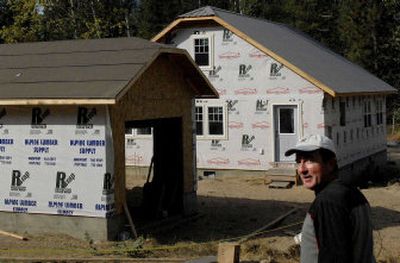

ELMIRA, Idaho – Nearly 100 years after Elmira’s brief fling as a western boom town, the clatter of construction echoes through the nearby forest.
Sandpoint developer Kent Compton bought this bit of Idaho history earlier this year. He plans to turn Elmira’s original town site into a development of period-style homes starting in the $152,000 range.
“I saw it as an opportunity to provide some relatively affordable homes in Bonner County,” said Compton, who’s also the developer of the high-end Retreat at Muskrat Lake south of Sandpoint.
Compton’s plans for a community of 16 modest homes began taking shape last fall, after he read a newspaper article about Elmira. The 4.3-acre town site was being advertised for sale for $675,000.
Compton declined to reveal how much he paid for the property, but said the price was low enough to keep costs reasonable. The narrow lots, platted in 1909, also dictated smaller houses.
A 900-square-foot house with two bedrooms and a bath will sell for $152,000. A 1,500-square-foot model with a second bath and an office costs $215,000. Each comes with a one-car detached garage.
Burt Mailman is purchasing a home in the development for $167,000. The 66-year-old retiree has been an apartment dweller for 16 years.
“The way it is around Sandpoint, they had priced me out of the market,” said Mailman, who’d considered buying houses off and on. “This is somewhat affordable. I was able to pull it off.”
Elmira lies about 15 miles north of Sandpoint, where the average sales price for a single-family home was $290,000 last year.
Elmira sprang up along a pack route to British Columbia’s gold fields. At one point, the settlement had a saloon, a school and a post office. After the 1950s, however, few residents remained on the original town site. The population gradually shifted west across U.S. Highway 95 to the unincorporated area known today as Elmira.
To create architectural designs compatible with Elmira’s past, Compton studied Sandpoint’s older neighborhoods, paying particular attention to small homes built in the 1920s.
He took pictures of rooflines, porches, gables and siding, amassing more than 300 photos.
Compton settled on two basic floor plans that can be tweaked for different looks.
The designs are called The Elva, The Grace, The Christine and The Elinor. Compton named them after his grandmothers and aunts.
“You won’t see a row of garages,” he said. “You’ll see houses with porches and garages in the back.”
Two homes are under construction at Elmira. During the ground-moving, Compton unearthed broken bottles, metal signs and old license plates, though he hasn’t “found any major prizes,” he said.
No old buildings remain on the site.
New Elmira residents will have a neighbor almost as old as the settlement itself.
BNSF and its predecessors have maintained a rail line near Elmira since 1889.
Each day, between 40 and 45 trains chug through the area, said Gus Melonas, BNSF spokesman.
The prospect doesn’t dismay Mailman. He’s accustomed to the sound of train whistle at odd hours.
“If you don’t like trains,” he said, “you can’t live in Sandpoint.”