
China backs N. Korea sanctions
UNITED NATIONS – China on Tuesday expressed a rare willingness to support U.N. sanctions against its ally North Korea but said any punitive action would have to be narrowly targeted at the country’s ballistic missile and nuclear weapons programs.
The United States and Japan continued to press the U.N. Security Council to support far stronger economic and trade measures that would permit international inspections of all North Korean cargo in search of weapons and strangle Pyongyang’s ability to finance its nuclear program.
A North Korean official said today that Pyongyang would regard sanctions in response to its claimed nuclear test as tantamont to a declaration of war. North Korea is already under limited sanctions by the United States and some allies.
“Sanctions are nonsense. If full-scale sanctions take place, we will regard it as a declaration of war,” the Beijing-based official, who wasn’t identified, told a South Korean news agency.
The statement is a reiteration of North Korea’s long-held stance on sanctions.
Varied responses to the nuclear test that North Korea apparently conducted early Monday emerged as the Bush administration sought to assuage fresh worries by its foreign counterparts that the tough strategy may cause hardship for the country’s impoverished population or topple the government. France, for instance, voiced concern that a Japanese proposal to ban all North Korean exports could fuel a humanitarian crisis.
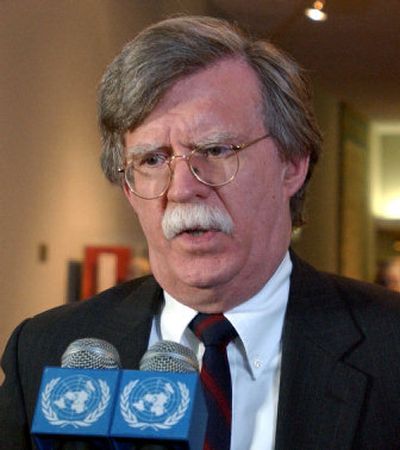
John Bolton, the U.S. ambassador to the United Nations, insisted that the U.S. sanctions plan calls for the exemption of food, medicine and other humanitarian goods for civilians. State Department spokesman Sean McCormack, meanwhile, specifically ruled out any attempt at regime change. “We have made it very clear that the United States has no intention to attack North Korea. That element of our policy still stands,” he told reporters. “What we have sought is a change in the behavior of the North Korean regime.”
China’s tougher stance against North Korea came as officials in Beijing faced criticism at home over their diplomatic strategy, which relies primarily on the now-stalled six-nation talks to contain North Korea’s nuclear program.
Chinese Foreign Ministry spokesman Liu Jianchao acknowledged that North Korea’s action “will undoubtedly exert negative impact” on the two countries’ relations. But he said the six-party talks remain “the best and practical way and effective way to resolve this issue, so I don’t think it’s a failure of China’s diplomacy.”
Still, Wang Guangya, China’s U.N. ambassador, conceded that the council would have to impose “some punitive actions” on Pyongyang to persuade it to heed international demands. He added, however, that “these actions have to be appropriate” and “more specifically targeted toward the nuclear- and missile-related areas.”
U.S. officials welcomed China’s willingness to consider punishing a traditional ally and neighbor that it has shielded from international pressure for decades. White House spokesman Tony Snow said China’s announcement suggested that North Korea’s ability to use “bluff and bravado” to obtain concessions may have ended.
Secretary of State Condoleezza Rice told CNN that “I’ve never seen universal condemnation of the kind that North Korea is now facing, and condemnation, by the way, not just from the United States and Europe and Japan but from its closest supporters, those who are the ones who give them assistance.”
But other U.S. officials made it clear that they think tougher measures are required to ensure that North Korea will not ignore another unenforceable council dictate. They note that a U.N. measure that was passed in July, Resolution 1695, already bans international trade in ballistic missiles and nuclear technology with North Korea. But it lacks any enforcement provision.
The United States supports a resolution under Chapter 7 of the U.N. Charter, which can be enforced by sanctions or military action.
The U.S. draft resolution calls for imposing stringent financial penalties on North Korea and providing broad powers to foreign governments to inspect all trucks, vessels and planes traveling in and out of the country. The U.S. text would also confront North Korea with a 30-day deadline to reverse course or face further penalties.
Japan has introduced a series of amendments that would ban North Korean exports and prohibit the arrival of North Korean ships or planes in foreign countries.