
California gives workers the dirt on worms
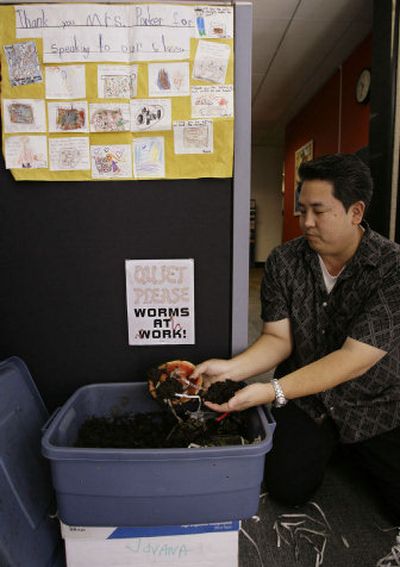
LOS ANGELES – Next to a copy machine on the 10th floor of the city’s public works building sits a plastic bin filled with worms wriggling in rotting lettuce.
Public servants walk by without even glancing at the box or the note above it: “Quiet please. Worms at work.”
Always on the cutting edge of all things environmental, California is encouraging public and private-sector employees to bring worms to work so that the creatures can chew up apple cores, sandwich scraps and other lunch leftovers and produce compost.
The employees are then invited to take the stuff home and use the all-natural fertilizer in their gardens and on their houseplants.
The state’s Integrated Waste Management Board is so serious about this that it has posted on its Web site a list of top 10 ways to recycle on the job, and No. 2 is: “Keep worms in your office.”
Supporters of the idea say that once you get over the ick factor, it’s not so bad. Open up a bin and it looks like a box of odorless, wet coffee grounds.
“Worms are the most forgiving pets you’ll ever own,” said Carol Parker, the “worm lady” who cares for the worms at the public works office. “You can go away for two weeks and ignore them and they’re fine.”
Tips for keeping happy worms are available on the state’s Web site. Among other things, it suggests buying your worms from a worm supplier to make sure you get the right kind.
To start a homemade bin, experts recommend putting down a little dirt and shredded damp cardboard or newspaper. Be sure to poke holes in the bin – air flow is necessary to promote decomposition and keep odors down – and make absolutely certain you’ve bought the right kind of worms. Apparently if they are not red worms, they may try to escape en masse.
The waste management board – part of the California Environmental Protection Agency – began promoting composting at least a decade ago, though the Top 10 suggestions are more recent. Andrew Hurst, who oversees the program at Cal EPA, acknowledged that only “very, very small numbers of businesses have worms.”
“It’s a weird thing to do,” he admits. “It’s not normal behavior to bring a bucket of worms to your office and put food scraps in there.”
At the Cal EPA complex in Sacramento, hundreds of thousands of worms process some 5 tons of food scraps per year. The 60-some bins are in offices, halls, even the day care center. There is a waiting list for bins among employees.
Over time, the caretakers have learned a thing or two about the worms’ preferences.
“Worms don’t like ranch dressing,” Hurst said.
They also seem to harbor a special dislike for bologna sandwiches, though any kind of dairy or meat product is problematic because of the smell, he added. Like other slender creatures, worms are also finicky about fatty foods and carbs, and eat bread only in moderation. Coffee grounds, on the other hand, and rotting fruit go over very well.