
Retirees call refueling depot risky

They have all the time in the world to fish, carve walking sticks or practice golf putts.
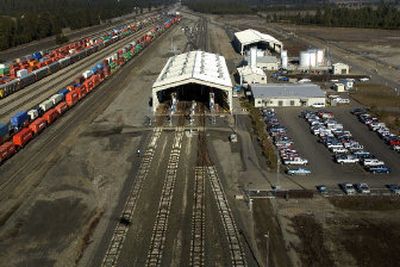
Instead, 88-year-old Jules Gindraux and his 69-year-old cohort, Jim Rowe, have been spending their time taking on a railroad. The two North Idaho retirees recently collaborated to produce a report focusing on risks posed by earthquakes to the BNSF Railway Co. refueling depot on the Rathdrum Prairie.
The resulting 50-page study was sent to policymakers and business leaders across the region. Gindraux, of Hayden, spent more than $600 just on photocopies and postage, he said. It’s all part of their quest to have the fuel depot moved off the top of the Spokane Valley/Rathdrum Prairie Aquifer.
“If we don’t look at the future and also the geological history of the state, we’re dooming ourselves,” said Rowe, of Coeur d’Alene. “It’s not a matter of if, it’s simply a matter of when.”
So far, none of the 47 officials, agencies or businesses that received the report has responded to Rowe or Gindraux – a fact that disappoints the retirees.
“It isn’t until people start to die that anything gets done,” Rowe said.
Post Falls Mayor Clay Larkin, a longtime depot critic, said he reviewed the report and found it “quite interesting.” Larkin is taking a closer look at the document. “It’s something that should be taken very seriously,” he said.
A copy of the report was sent to BNSF Railway. Spokesman Gus Melonas has not seen the report, but said the facility was designed with greater earthquake protections than required by Kootenai County building codes. “It was designed one level higher than what the code requires,” Melonas said.
The high-speed refueling depot opened two years ago. Within months, a series of fuel leaks was discovered at the $42 million facility. An estimated 1,800 gallons reached the aquifer 160 feet below the depot. The aquifer supplies drinking water to about 500,000 people across the region.
State officials say no trace of fuel has been found in groundwater outside the site boundaries.
Since the leaks were discovered, the railroad has spent $19 million fixing the problem and siphoning the fuel out of the aquifer. Some of the fixes took place during a court-ordered shutdown, which lasted 10 weeks.
Gindraux and Rowe remain bitter the facility was not permanently shuttered or forced to relocate atop beds of impermeable basalt, which they say would help safeguard the aquifer. Much of their concern focuses on earthquakes. Rowe was working on a road-building crew near Yellowstone National Park in 1959 when a massive quake hit, killing 28 people and causing the ground to heave “like waves on the ocean,” Rowe recalled. “I pretty near got killed down there.”
Rowe’s quest is also fueled by the legacy of pollution in his native state of Montana. Residents in Libby have been sickened and killed by asbestos. Copper mines have fouled his hometown of Butte. Twenty-five sites across the state have been contaminated by BNSF Railway, according to the Montana Department of Environmental Quality.
Rowe doesn’t want to see the same happen here.
“I’m not an ecofreak,” said Rowe, who has never before worked on an environmental campaign. “We as humans can use the good earth we’re part of, but there’s a difference between using and abusing.”
According to federal and state data included in their report, Idaho is the sixth-most seismically active state, and at least 12 fault lines crisscross the Inland Northwest, including the Hope Fault along the northeast shore of Lake Pend Oreille.
According to information from the U.S. Geological Survey, the Rathdrum Prairie and surrounding areas have a 40 percent to 50 percent chance of experiencing an earthquake with a magnitude of 5.0 or higher in the next 100 years. A magnitude-5.0 quake could be expected to move heavy furniture in houses, but only cause “slight damage” to buildings, according to the agency.
No quakes larger than magnitude 5.0 have been reported in the region since record keeping began in 1872.
Nonetheless, Rowe and Gindraux are convinced the depot would be vulnerable should a large quake hit the region. On any given day, the facility stores 500,000 gallons of diesel fuel. Unlike buildings and roads, which could be rebuilt, the aquifer could be poisoned for generations should storage tanks and concrete be cracked by an earthquake, Gindraux said.
“Imagine the breadth of consequences of our water being destroyed,” he said.
Previous leaks notwithstanding, railroad officials have pointed out their facility has some of the most advanced technology in use anywhere in the region aimed at protecting the aquifer. The storage tanks at the depot have double walls and bottoms. Experts believe at least 30 million gallons of petroleum are stored atop the aquifer in aging, single-walled tanks in Spokane County.
Gindraux said he recognizes the other risks, but feels the depot is the biggest single threat to the aquifer.
Neither retiree has a background in engineering. Gindraux, a Spokane native, served as a pilot in World War II and spent the following three decades flying the globe commercially, including helping to start Lebanon’s national airline. Rowe briefly taught math and science, but spent much of his career working as a physician recruiter. Rowe has also worked at a mine and in a railyard.
The two acknowledge their report will not likely prompt the relocation of the depot. They compare their efforts with the reports issued before Hurricane Katrina, which showed New Orleans was not adequately protected by flood levees.
“It’s our civic duty,” Gindraux said. “How can people sit back and ignore these things?”