
Mercury in cars raises concern
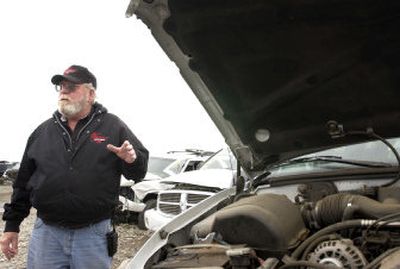

In the wrecking yard of Spalding Auto Parts, Lavoy Jacobsen cracks open the hood light from the crunched carcass of a Chevy Suburban and produces a bullet-size capsule of hazardous mercury.
“See that? That would contaminate about a 45-acre lake,” said Jacobsen, a Spalding’s supervisor. “It’s a very insidious type of thing. That’s what’s harming the south end of Lake Coeur d’Alene.”
The U.S. Environmental Protection Agency estimates there are nearly 250 tons of mercury stowed in the automatic light switches and anti-lock brake boxes of America’s cars.
Mostly, the capsules are found in automatic trunk and hood lights of cars produced between 1974 and 2002.
And roughly 10 tons of the hazardous matter winds up in auto junkyards every year, where mercury might spill out when cars are shredded or vaporize when junked cars are melted down.
Now there’s a push to remove at least 75 tons of the mercury from junk vehicles in the next 15 years, before it contaminates waterways.
Even in small amounts, such as in contaminated fish, the liquid metal can cause nervous system damage and learning disabilities in humans when consumed.
Pregnant women, infants and children are most at risk.
In August, the steel and auto industries reached an agreement with the Bush administration to retrieve the switches from scrap vehicles, although there’s nothing in federal law mandating such a cleanup.
Each industry agreed to contribute $2 million for switch recovery, and states such as Washington are already tapping into the fund.
Washington, following the lead of California and New Jersey, launched a switch recovery program last spring. The state makes sure junkyards like Spalding’s have plenty of three-gallon buckets to collect the mercury switches.
Washington keeps track of what’s being collected and makes sure businesses receive $3 per switch for their trouble.
“We’ve collected 12,000 switches already,” said Jan Brydsen, a compliance assistance officer with Washington’s Hazardous Waste and Toxics Reduction program.
The number of collected switches ranks Washington fourth among 14 states collecting switches for a recovery company formed by the steel and auto industries, the End of Life Vehicle Solutions Corp.
Idaho doesn’t participate in that program, though regional auto salvage trade organizations urge junkyards to remove the mercury regardless of state activity.
Russ Spalding said his family business has been collecting mercury switches for years in anticipation of federal requirements.
The U.S. Environmental Protection Agency identifies mercury car switches as the nation’s fourth leading contributor to the mercury problem.
Critics of the Bush administration’s recovery pact with auto and steel industries say the program is underfunded, that the trouble of removing the switches isn’t worth the compensation of $1 to $3 depending on the junkyard’s home state.
The final destination of the recovered mercury has also been scrutinized.
A Wall Street Journal investigation in April revealed that after changing hands multiple times, recycled mercury is passed on to the world’s biggest mercury markets, the gold mines of Asia, African and South America, where pollution controls are minimal.