
Affordable housing focus of developer’s plan
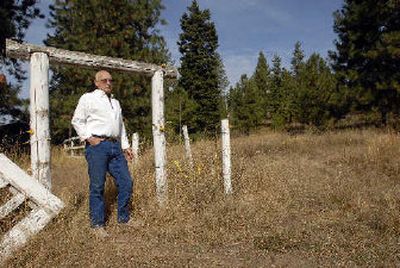
Stan Huffaker is comfortable operating outside the proverbial box. “The people at the city look up when they see me walk in their door and ask, ‘What do you want now?’ ” he says with a confident grin.
Huffaker, an architect and developer, is accustomed to working on the cutting edge of design and technology in urban areas all over the world. Having brought his vision, passion and expertise to Kootenai County more than a decade ago, he currently finds himself in the spotlight as city and county officials are immersed in the issue of providing affordable housing for the area’s workforce.
Huffaker graduated in 1961 from University of Southern California with a bachelor’s degree in architecture. In 1963 he was licensed as an architect, allegedly the youngest licensed architect in the state of California at the time. He enjoyed a 30-year career working on such varied projects as remodeling LAX, modifying airports to accommodate the “new” jumbo jets, overseeing and/or participating in the building of children’s hospitals in Mexico and Africa, a fleet of hospital boats in Vietnam, and the international airports in Munich, Germany and Santiago, Chile. The list of projects also includes hotels, resorts, apartments, shopping centers, industrial and commercial buildings.
In the early 1970s, Huffaker helped define the term “condominium” for the state of California, and built the first condos and began converting apartment buildings to condos. A condo, by definition, implies ownership of real estate. A condo can take the form of an apartment, a traditional single-family home, or even a boat slip, as in the condo marina on South 11th Street in Coeur d’Alene.
In 1994, Huffaker and his wife moved to Coeur d’Alene. Two years earlier, he had begun work on The Village condos on North Fourth Street. The project appeals to “empty nesters” (50 to 80 years of age) and was the first large-scale project of its type in this area, with 185 families living in Village 1, and 50 families in Phase 2. Huffaker writes: “This multiphase project was designed to meet the needs for homeowners who want to simplify their lives by living in a maintenance-free community with quality amenities. The project has a recreation center, indoor pool and spa, private RV parking, putting green, tennis court and community garden. Each unit functions as a private residence with its own private garage and backyard.” The Village condos sell for around $160,000.
Enter Randy and Jane Edwards. Randy, a physical therapist, is currently the director of Rehabilitation at Kootenai Medical Center and a mixed media artist, and his wife, Jane, who has a master’s degree in nursing, teaches nursing at North Idaho College.
The Edwards sought a 3,000-square-foot home in the Fort Grounds neighborhood a decade ago and have spent the past several years transforming it from “a place that didn’t fit the ambience of the Fort Grounds” in Randy Edwards’ estimation to a work of art, putting in cobblestone pavers and carriage house doors, replacing all the windows and installing a professional kitchen. They brought it up to professional quality, with the appearance of an East Coast ocean cottage.
“That was the home we wanted to retire in. We couldn’t help working on it, because of our love for the area and for the house itself,” said Randy Edwards.
When they first bought their Fort Grounds home, the property taxes were $1,800 a year. Last year they were $6,000, “with no end in sight,” according to Edwards. “We had a sense that there was no way we’d have retirement that could equal the taxes, when there’s no cap on property taxes.”
The Edwards decided to put their home on the market. They listed it in November 2005, and it sold quickly. They moved into The Village condos to simplify their lives and get completely out of debt, “something that was only a dream before,” says Edwards. They have plans to move to the country within the next year and simplify their lifestyle even further.
Edwards continues, “I think it’s immoral that we’re doing this to our elderly people. It seems like a greedy monster that is bent on harming the community. We are people with hopes and expectations and plans and careers and dreams. When the county taxes us to the point of losing our homes, it’s disheartening. We have major issues with recruitment here at KMC. It’s difficult to recruit because of the cost of housing – and I’m talking about physicians, physical therapists – professional folks.”
Huffaker is as concerned as Randy Edwards, but his latest project is aimed at the emerging market and workforce housing. Companies such as Buck Knives, which recently moved to Post Falls, come to this area and bring their workforce with them. These employees have decent jobs at good companies but can’t find affordable housing.
Pennsylvania Highlands is the name of Huffaker’s next project. He writes, “With the increase in price of the existing housing base in the downtown general area, there are no affordable residences left in the price ranges necessary to support the workforce housing. The developers have procured a 13-acre parcel of land east of the I-90 Freeway and adjacent to Sherman Avenue on the south and intersecting Pennsylvania Avenue and 23rd Street on the north.” The purchase price will range between $110K and $150K for a 2-bedroom, 2-bath unit, and up to $175K for a 3-bedroom home. The rental range is $650-$900.
Huffaker continues, “We are proposing to develop four-plex type buildings in this area. They can be purchased as an owner-occupied master unit with three rental units attached. That can be set up for retired buyers who want to own and manage their own rental units and live in the master unit rent-free. Or the buildings can be sold as a four-unit condominium building with individual ownership for each of the units. This would provide ownership in the forecast ranges for Workforce Housing. With state and federal down-payment programs, young people can move in with little or no money down and have ownership in their own residence.” There also will be 36 apartment units in the community.
The face of housing in Kootenai County is changing. Huffaker has the experience, expertise and most of all, the passion to play a major role in effecting these changes with decency and pride. He says, simply, “The public needs a place to live.”