
For a time, a river ran through it
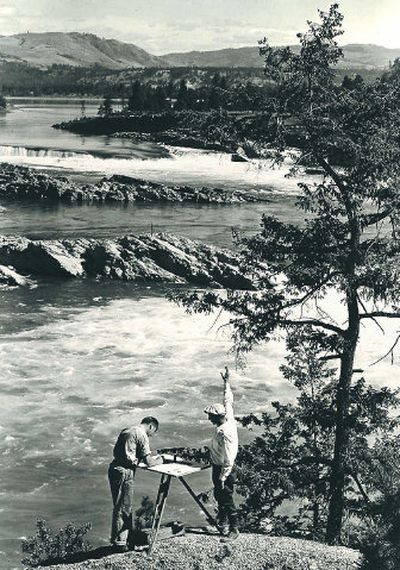
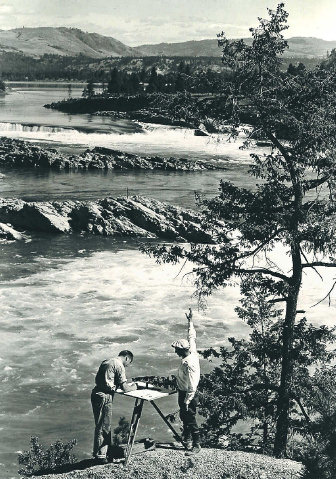
An entire generation – make that two or three generations – have grown up with only the vaguest idea that Kettle Falls was once an actual falls. Not just any falls. Kettle Falls rivaled any spot on the entire 1,243 miles of the Columbia River for its historic and cultural importance. This rolling, boiling slash of river was a phenomenally productive salmon-fishing spot; the site of a cedar-planked Indian village; and a summer rendezvous for tribes hundreds of miles around. The fur trader and explorer David Thompson certainly discovered this when he arrived at Kettle Falls in 1811.
“Here was a considerable village of Natives who have given their name to these Falls, which are about ten feet of descent in a steep slope, in places broken,” wrote Thompson in his journal.
It came to be called Kettle Falls, probably because of the natural bowls scooped out of the rock by the force of the torrent.
The tribe, now called the Colvilles, built complicated cedar sheds, “20 feet in breadth, built of long boards which somehow they had contrived to split from large Cedars drifted down the river.” These sheds were filled with drying salmon just hauled from the roaring falls.
This village was already many thousands of years old. Bands of early migrants gravitated to this spot, not just for its prolific salmon, but also for the particularly fine, hard quartzite. Thousands of stone tools still lie scattered around the hills.
Yet the chinook was clearly king. The fish runs, beginning in June and continuing throughout the summer, were simply staggering. The upper and lower falls created a natural stacking point for every salmon heading into the 550 upstream miles of the Columbia (plus tributaries).
Nobody knows how many salmon leapt these falls every year, but early observers said that the Indians routinely harvested 400 salmon a day, and on one particularly lucrative day, 1,700.
They made six-foot wide willow baskets and anchored them in the falls. The upstream side of the basket was higher; the downstream side was lower, forming a kind of J-shaped trough. The chinook would leap up the falls, fall onto the high side of the basket and get caught in the trough at the bottom. Then a brave man would lower himself into the frothing basket and hand the 30-pound monsters to people on the rocks above.
The resident Colville and Lake tribes had most of the early run to themselves, but as the summer progressed, many other tribes showed up to claim a share: the Okanagan, Sanpoil, Spokane, Kalispel, Flathead, Coeur d’Alene and Kootenai. Even more distant tribes, such as the Nez Perce and the Palouse, routinely showed up. A Colville “salmon chief” distributed allotments to all comers.
The gathering was, in Thompson’s words, “a kind of general rendezvous for news, trade and settling disputes.”
Kettle Falls was, in short, “the center of civilization for this part of the river,” wrote David H. Chance, author of “People of the Falls,” (1986, Kettle Falls Historical Center).
Kettle Falls remained a key fishing and gathering spot long after the Europeans arrived. A new Hudson’s Bay Co. trading post, Fort Colvile (without the added ‘l’) was built near the falls in 1825; the Jesuits built the St. Paul’s mission within the sound of the water in 1847. In fact, the Jesuits baptized their new converts right on a rocky peninsula of the fishery.
A steamboat arrived above the falls to ferry gold miners upriver in the 1860s. Settlers arrived and built cabins. Then in 1889, the small town of Kettle Falls was founded on the banks. The town went through a number of boom and bust cycles over the next decades, resulting in the ultimate bust in 1939.
That’s when the federal government uprooted the entire town, population 400, put it on trucks and moved it to a new site three miles away. The new site was also, crucially, much higher in elevation. The Grand Coulee Dam, about 100 miles downstream, was poised to flood the old town 30 feet deep and shut down the salmon run.
The higher, drier town of Kettle Falls thrived after the move and now has a population of around 1,500.
The falls themselves did not fare so well. In June 1940, tribes from all over the region gathered to bid the mighty cascade one final goodbye. They called it, tellingly, “a ceremony of tears.”
A newspaper account the next day neglected to quote any of the Indian leaders. Instead, it quoted former Senator C.C. Dill, who said he hoped that “the Indians of future generations, as well as the white men, will find the change made here a great benefit to the people.”
The water slowly continued rising until, by 1941, Kettle Falls ceased to thunder. The falls were effectively stilled – or, you might say, laminated – under the glassy surface of Lake Roosevelt.
But not forever. In 1969 and again in 1974, Grand Coulee engineers drew down Lake Roosevelt so low that Kettle Falls reemerged for several months. Thousands of residents, white and Indian, flocked to those ancient rocks and felt the ancient thunder.
The salmon, of course, failed to show.