
Panama Canal expansion OK likely

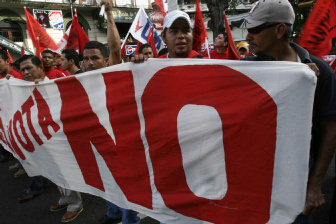
PANAMA CITY, Panama – Voters probably will approve a $5.2 billion project to expand the Panama Canal today, according to polls, despite warnings of an accumulation of debt, competition, technical miscalculations in the project and possible environmental damage.
Only scattered opposition has developed to the proposal to expand the 92-year-old canal to allow transit of a new and larger generation of container ships. If voters approve, construction would begin next year and finish in 2014, in time for the 100th anniversary of the canal’s opening.
Opponents, who include a former Panamanian president, a one-time canal administrator and assorted engineers and financiers, say the expansion amounts to fixing something that isn’t broken, and that the nation is risking its most important asset on dubious engineering and financial assumptions. Revenue from the canal accounts for 8 percent of the national budget.
The contrarian views have been obscured by the well-oiled campaign by the government of President Martin Torrijos to sell the expansion as a competitive necessity. Polls indicate that support for expansion has grown in the weeks leading up to the vote and that the referendum could pass by as much as 2-to-1.
Canal administrators and many shipping experts contend that the canal risks becoming irrelevant unless it modernizes, because of the enormous growth of container cargo traffic bound to and from the U.S. East Coast since the emergence of China as a world trader.
The rising volume has lengthened the waiting time for ships at either end of the canal. Alternative projects including a waterway in neighboring Nicaragua have been proposed to handle the extra traffic. An expansion of the Suez Canal also is being considered, as are several projects to hurry freight across North America from new Canadian and Mexican ports.
If the referendum passes, the canal expansion would involve digging a third shipping lane and construction of a parallel set of locks for ships half-again as large as those that currently transit the 51-mile canal.
The project would be entirely self-financed by the doubling of tolls over the next 20 years, said Francisco Miguez, master plan coordinator at the Panama Canal Authority, the quasi-independent body that has run the canal since the United States turned it over at the end of 1999. The authority would manage the expansion, as well.
But skeptics warn that cost overruns are inevitable, and that they will be shouldered by taxpayers. Walter Molano, an analyst with BCP Securities in Connecticut, said Panama is already burdened with high debt and poverty and is underestimating how much competition will force it to keep its prices down in coming years.
Carlos Guevara-Mann, a Panamanian who is a political science professor at the University of Nevada-Reno, said the project still lacks a thorough economic study or final construction plans.
Paul Labonte, a Tustin, Calif.-based civil engineer who helped develop an alternative canal water recycling plan financed by the Inter-American Development Bank, claims the final plan badly underestimates the amount of water the new locks will require.
If the global warming trend continues, the project risks environmental damage due to rising sea levels and creeping salinity, he said, as well as possible competition from the Northwest Passage later in the century.